
How much does in-home care cost?

|
Updated: June 20, 2026
|
Fact Checked
|
Cite this Research
Cite this research
APA
Gamburd, M. (2026, June 20). How much does in-home care cost? CARE Homecare. https://carehomecare.com/research/in-home-care-cost
MLA
Gamburd, Moti. “How Much Does In-Home Care Cost?” CARE Homecare, 20 June 2026, https://carehomecare.com/research/in-home-care-cost.
Chicago
Gamburd, Moti. “How Much Does In-Home Care Cost?” CARE Homecare. Last modified June 20, 2026. https://carehomecare.com/research/in-home-care-cost.
Article link
Research highlights: As of the 2025 CareScout Cost of Care Survey, in-home care costs a national median of $35 per hour, which works out to roughly $6,673 per month or $80,080 per year at 44 hours of care a week. Rates range from $24 per hour in Mississippi to $46 per hour in Wyoming. Over the past five years, the in-home care median has climbed about 46%, compared with roughly 24% cumulative inflation over the same period.
Related research: How much do home health aides make? | How long will Medicare pay for home health care? | Home care vs nursing home cost | Does Medicaid pay for home care?
How much does in-home care cost per hour?
The national median for in-home care is $35 per hour in 2025. That figure covers a non-medical caregiver who helps with bathing, dressing, meals and light housekeeping. It is private-pay pricing, not a Medicare or Medicaid reimbursement rate.
Hourly pricing is where most families start, because agencies bill in hourly blocks. The catch is that private home care, care you pay for directly through an agency, sits at that same $35 median whether you call it companion care, personal care or homemaker service.
If you need clinical care at home rather than help with daily tasks, the math changes. Skilled nursing in the home, meaning a licensed private-duty nurse, carries a national median of $90 per hour in 2025.
That gap of more than 2.5 times makes the type of care, non-medical help versus skilled nursing, one of the biggest cost drivers in home care.
| In-home care type (2025) | National median hourly rate |
|---|---|
| Non-medical caregiver (personal and companion care) | $35 |
| Skilled nursing in the home (private-duty nurse) | $90 |
Curious what the people delivering that care actually take home? See our breakdown of home health aide and caregiver pay.
How much does in-home care cost per month and per year?
At the national median of $35 an hour, in-home care costs about $6,673 per month and $80,080 per year. Those numbers assume 44 hours of care a week across 52 weeks.
Why 44 hours? The annual non-medical in-home care baseline is calculated on 44 hours per week over 52 weeks, so this article uses that same baseline for every monthly and annual estimate.
It reflects a part-time care schedule rather than around-the-clock coverage, which is priced separately below.
This monthly figure applies to private-pay, non-medical in-home care, often searched as senior home care, elderly home care, companion care or personal care.
Clinical home health services and private-duty nursing are different, pricier categories, which we separate out below. For non-medical care, the main things that move your real monthly bill are the number of hours you book and the state you live in.
| In-home care (non-medical caregiver, 2025) | National median |
|---|---|
| Per hour | $35 |
| Per day (blended, annual divided by 365) | $219 |
| Per month (44 hours per week) | $6,673 |
| Per year (44 hours per week) | $80,080 |
How much does 24-hour and 24/7 in-home care cost?
This is where sticker shock sets in. There is no separate 24-hour or 24/7 survey median, so the honest way to size it is to multiply the verified $35 hourly rate by the hours involved. At that median, 24 hours of care costs about $840 per day.
Stretch that to genuine around-the-clock coverage, billed hourly, and the cost is roughly $25,480 to $25,550 per month, depending on whether you calculate it as 168 hours per week over 52 weeks or as 24 hours across all 365 days.
Either way, that works out to about $306,000 a year. These are estimates derived from the $35 median, not survey medians, but they show why continuous hourly care can become financially unrealistic for many households.
State pricing widens the spread further. At Wyoming’s $46 hourly rate, a 24-hour day runs about $1,104; at Mississippi’s $24 rate, the same day costs roughly $576.
The takeaway is simple: continuous hourly care is often one of the most expensive ways to receive support at home.
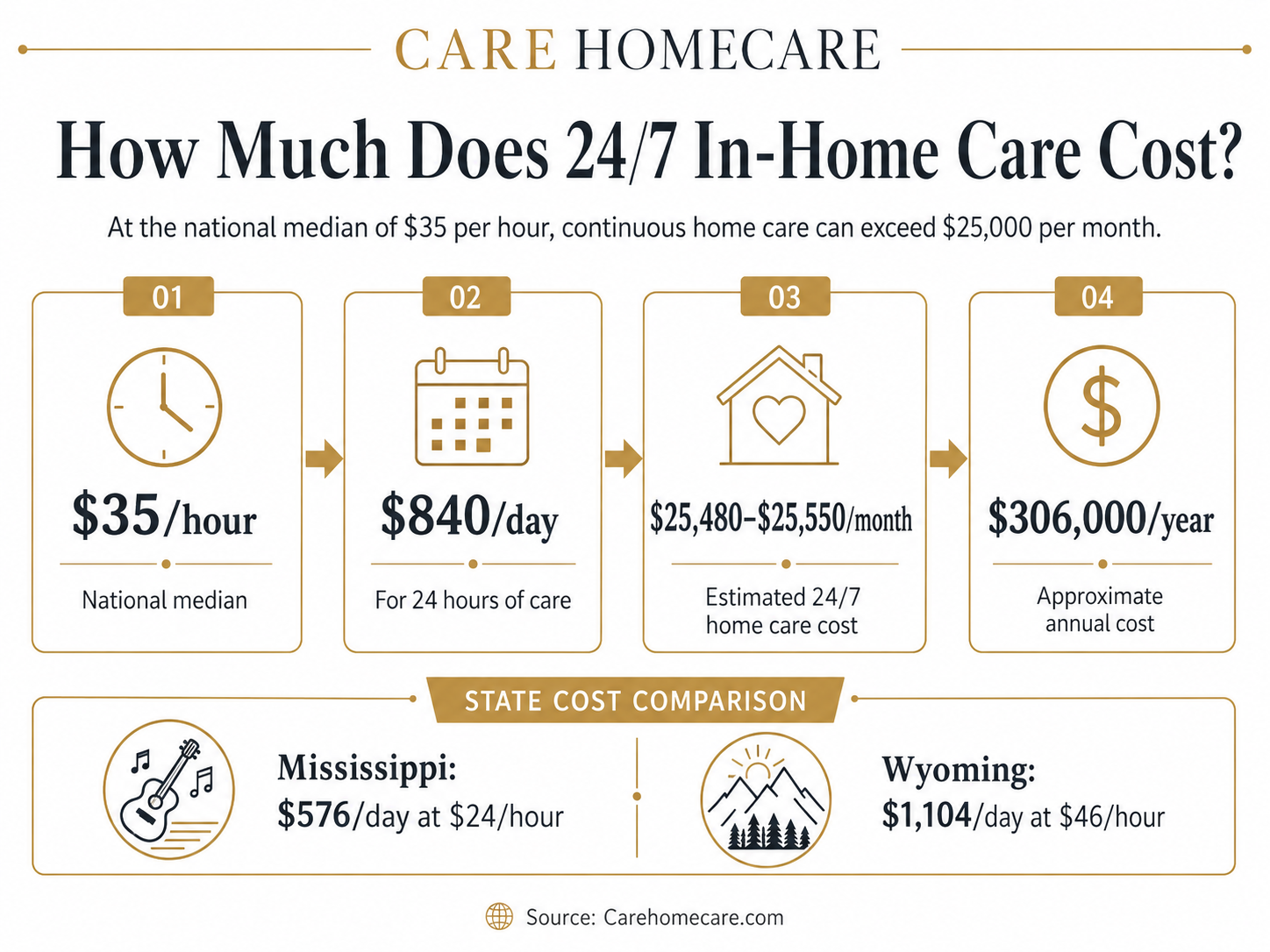
At the national median of $35 per hour, 24/7 in-home care can exceed $25,000 per month and cost about $306,000 per year.
How much does live-in home care cost per week?
Live-in care, where a caregiver actually resides in the home, is billed differently from hourly care, which is exactly why families turn to it. Instead of paying for every one of the week’s 168 hours, live-in arrangements are often structured around a flat daily rate.
No official weekly live-in care median is published in the 2025 survey data. As a ceiling, continuous hourly care at the $35 median would run about $5,880 a week.
Some live-in arrangements may cost less than 168 hours of hourly care because sleep time and off-duty time may be treated differently, but billing rules vary by agency and state.
If round-the-clock needs are pushing your weekly cost toward that ceiling, it is worth pricing live-in care and a move to a facility side by side. Our comparison of home care versus nursing home costs lays out the break-even point.
What is the median daily cost of in-home care?
The median daily cost of in-home care is about $219 in 2025. That number is the annual median ($80,080) divided across 365 days. It reflects a normal 44-hour care week spread across the calendar, not a full 24-hour shift.
It is an easy figure to misread, so keep two daily numbers straight. The $219 blended day is what a typical week of part-time care averages out to across the year.
The $840 day from the previous section is what a literal 24 hours of continuous staffing costs. Both come from the same $35 hourly rate; they just count different hours.
How much does in-home dementia care cost?
There is no separate dementia-specific median for in-home care in the 2025 survey data. A caregiver supporting someone with Alzheimer’s or another form of dementia is often billed at the same $35 national median for non-medical care.
For planning purposes, the main driver is usually the number of supervised hours needed, not a premium hourly rate.
That said, hours can climb fast. Dementia care often demands supervision the average client does not need. Wandering, sundowning and safety risks can push families toward 24-hour coverage, which is where the $840-a-day and $25,000-plus monthly figures come into play.
Some agencies may also charge more for specialized memory care or overnight supervision, so it is worth confirming rates locally.
For context on how widespread this need is, the federal government estimates that someone turning 65 today has almost a 70% chance of needing some type of long-term care in their remaining years.
Homemaker, companion and home health aide costs: why the rates merged
For years, homemaker or companion care, meaning hands-off help like cooking and cleaning, cost slightly less than a home health aide, meaning hands-on help like bathing and dressing.
In 2024, homemaker services ran about $33 an hour ($75,504 a year) against roughly $34 for an aide ($77,792 a year).
That gap has essentially vanished. The 2024 data found that two-thirds of home care agencies now charge the same rate for both services. By 2025, those services had been folded into a single non-medical caregiver category priced at $35 an hour.
The practical lesson: do not expect a discount for booking just companion care. If you genuinely need clinical tasks performed, that is a different and pricier service, the $90-an-hour skilled nursing tier covered earlier.
How much has in-home care cost increased over the past 5 years?
In-home care has gotten markedly more expensive. The annual median for a home health aide was $54,912 in 2020. By 2025, the equivalent non-medical caregiver median had reached $80,080.
That is an increase of roughly 46% in five years, or about $25,000 more per year on a comparable 44-hour-per-week home-care baseline.
On an annual basis, the median climbed from $54,912 to $80,080, or from around $24 to $35 an hour. For comparison, general consumer prices rose about 24% cumulatively over the same 2020 to 2025 period, so care costs grew at roughly twice the pace of inflation.
A note on this comparison: the 2020 figure reflects Genworth’s home health aide category, while 2025 uses CareScout’s merged non-medical caregiver category, so the 46% should be read as an approximate five-year trend rather than a precise like-for-like calculation. Both are measured on the same 44-hours-per-week basis.
| Year | Annual median (in-home care) | Approx. hourly |
|---|---|---|
| 2020 (home health aide) | $54,912 | ~$24 |
| 2024 (home health aide) | $77,792 | ~$34 |
| 2025 (non-medical caregiver) | $80,080 | $35 |
Which states have the most and least expensive in-home care?
Geography is a huge cost driver. The priciest state for in-home care in the 2025 ranked data is Wyoming at $46 per hour ($8,771 a month), followed by Vermont and Washington.
At the other end, Mississippi is the least expensive state in that ranking at $24 per hour ($4,576 a month), with Arkansas and Louisiana close behind.
That spread means the same weekly care plan can cost nearly twice as much depending on your zip code.
| Most expensive states (2025) | Hourly | Monthly | Annual |
|---|---|---|---|
| Wyoming | $46 | $8,771 | $105,248 |
| Vermont | $45 | $8,580 | $102,960 |
| Washington | $45 | $8,580 | $102,960 |
| Maine | $44 | $8,485 | $101,816 |
| South Dakota | $44 | $8,437 | $101,244 |
| Least expensive states (2025) | Hourly | Monthly | Annual |
|---|---|---|---|
| Mississippi | $24 | $4,576 | $54,912 |
| Arkansas | $25 | $4,767 | $57,200 |
| Louisiana | $26 | $4,957 | $59,488 |
| Alabama | $27 | $5,148 | $61,776 |
These are private-pay medians. What public programs cover is a separate question, which we tackle in our guides to Medicare home health coverage and Medicaid home care.
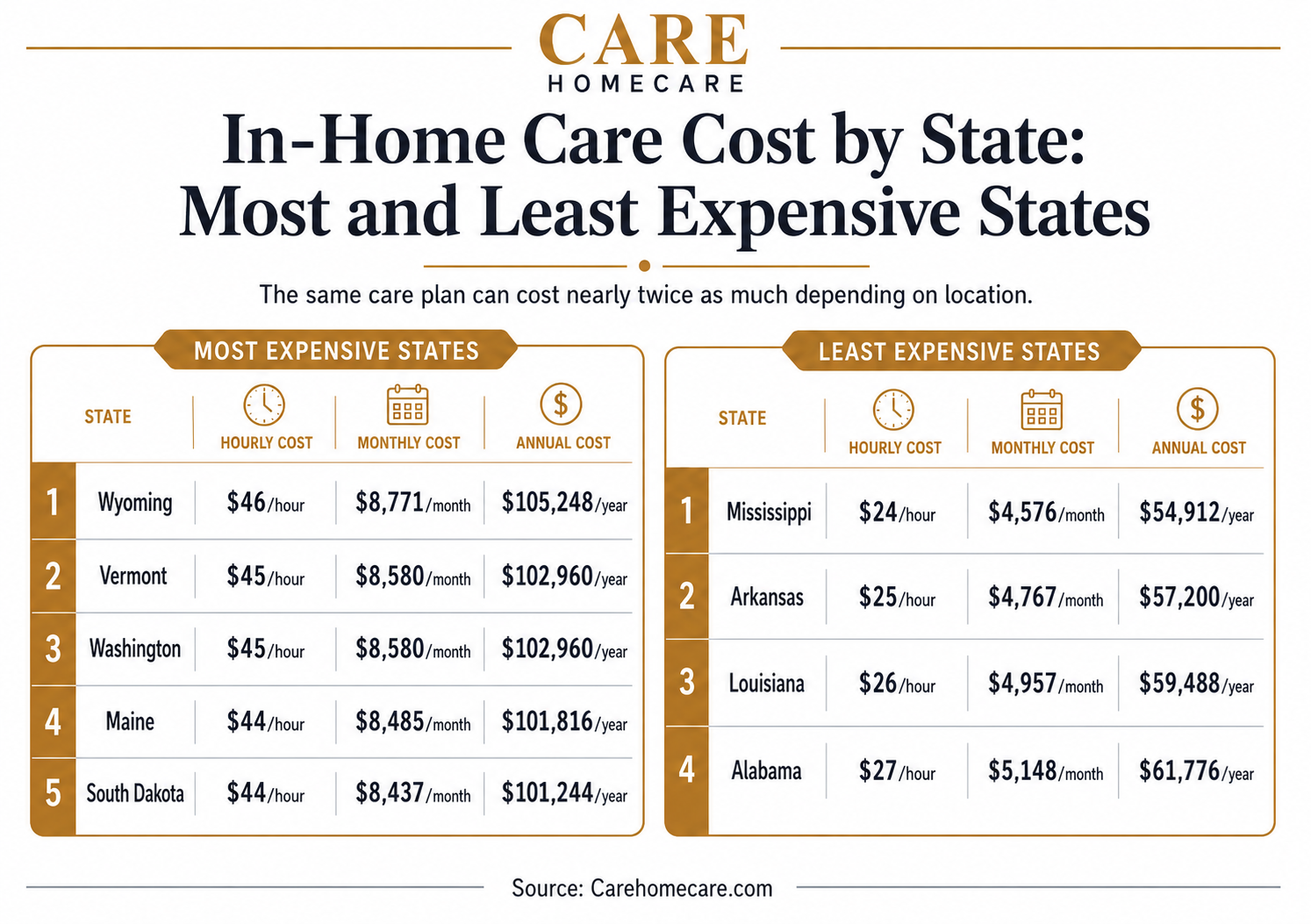
In-home care costs vary widely by state, with Wyoming reaching $46 per hour and Mississippi at $24 per hour. The same care plan can cost nearly twice as much depending on location.
Sources & additional resources
- CareScout. “Cost of Long-Term Care by State: Cost of Care Report.” CareScout.
- CareScout. “Ranked Median Costs by State Data Tables, Cost of Care Survey 2025.” CareScout.
- Genworth Financial. “Genworth and CareScout Release Cost of Care Survey Results for 2024.” Genworth Newsroom.
- Genworth Financial. “Genworth 17th Annual Cost of Care Survey.” Genworth Newsroom.
- Federal Reserve Bank of Minneapolis. “Consumer Price Index, 1913-.” Minneapolis Fed.
- Administration for Community Living. “How Much Care Will You Need?.” ACL.gov (LongTermCare.gov).
For families comparing in-home care costs, CARE Homecare provides personalized in-home care services across Los Angeles and Orange County. Care plans can include help with daily routines, companionship, mobility support, meal preparation, medication reminders and light housekeeping. For loved ones who need continuous support, CARE Homecare also offers 24-hour home care tailored to each client’s needs, schedule and level of independence.
Disclaimer: This article is for informational purposes only and is not medical, legal, financial or insurance advice. Care costs, coverage rules and service availability can vary by location, provider, care needs and payer. Families should speak with qualified care, medical, legal or financial professionals before making care decisions.
Quick Scroll To:
- How much does in-home care cost per hour?
- How much does in-home care cost per month and per year?
- How much does 24-hour and 24/7 in-home care cost?
- How much does live-in home care cost per week?
- What is the median daily cost of in-home care?
- How much does in-home dementia care cost?
- Homemaker, companion and home health aide costs: why the rates merged
- How much has in-home care cost increased over the past 5 years?
- Which states have the most and least expensive in-home care?
- Sources & additional resources