
Contents
Different Types of Home Care
Medical, Non-Medical & Specialty Care
Key Takeaways
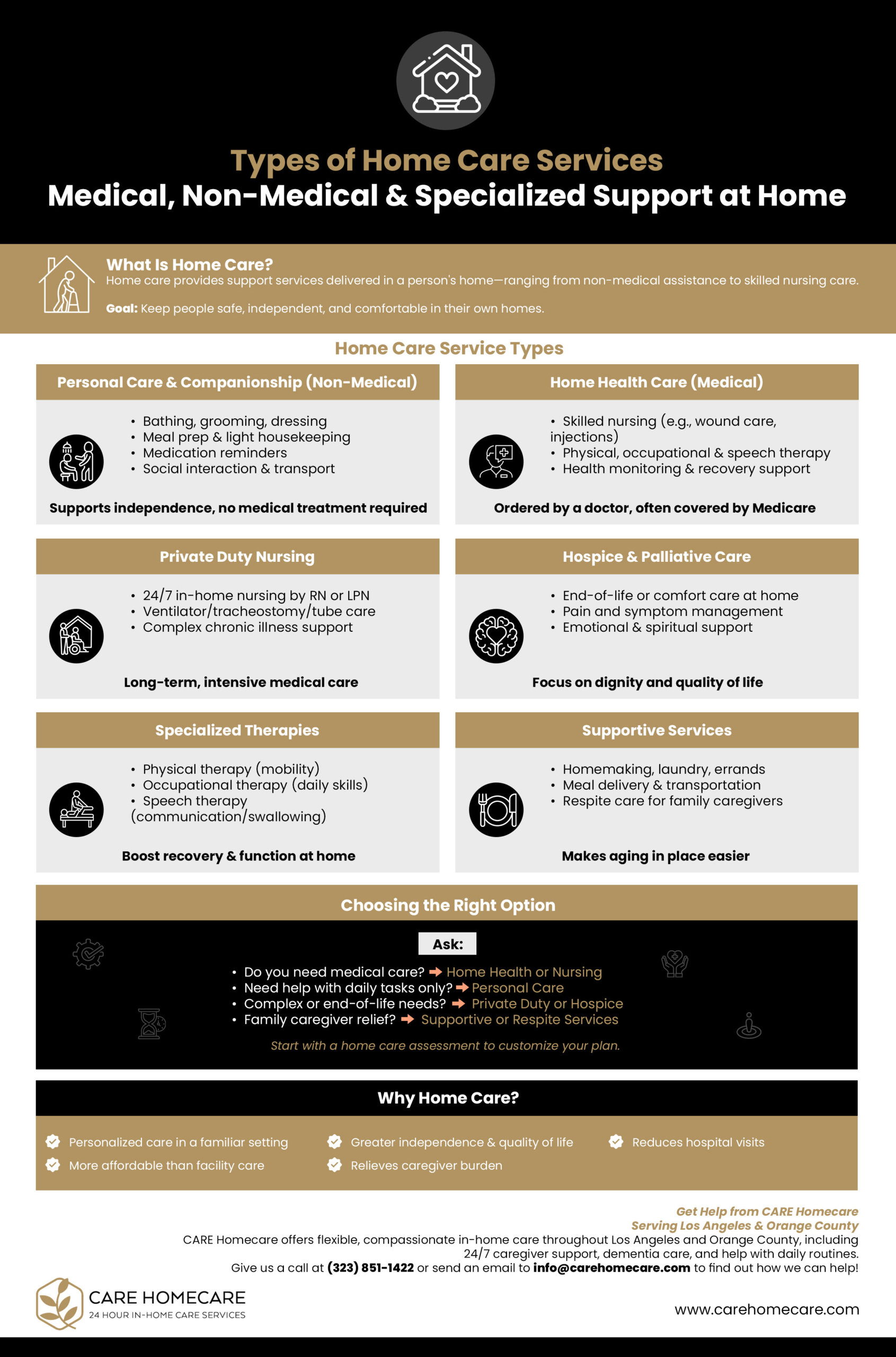
- Home care includes a wide range of services delivered in a person’s own home, from basic daily assistance to complex medical care.
- Personal care and companionship help with everyday activities like bathing, dressing, and meal preparation, supporting safety and independence without medical treatments.
- Home health care provides skilled medical services, including nursing, therapy, and monitoring of chronic conditions, usually under a doctor’s orders and often covered by insurance.
- Private duty nursing offers extended or 24-hour in-home medical care from licensed nurses for individuals with serious or complex health needs.
- Hospice and palliative care bring compassionate end-of-life support and symptom management to the home environment.
- Specialized therapy services such as physical, occupational, and speech therapy, help people recover abilities and maintain quality of life.
- Supportive services like homemaker help, meal delivery, and respite care make aging in place or recovering at home easier for both clients and families.
- Choosing the right type of care starts with an assessment of medical needs, personal preferences, and daily challenges to create a customized plan.
Home care has become one of the most important resources for older adults and individuals recovering from illness or injury. Rather than moving into a nursing facility, many people prefer to stay in the comfort of their homes, where they feel most secure.
But what exactly is home care, and what are the different types of home care services available?

What Is Home Care?
“Home care” is a broad term that describes support and health care services provided in a person’s own home. Depending on your needs, home care may include non-medical help with everyday tasks, skilled nursing care, or specialized health services.
At its core, home care empowers people to remain where they feel most comfortable while receiving the level of assistance necessary for their health, safety, and well-being.
If you’re wondering what home health care is and how it differs, the term typically refers to care delivered by licensed medical professionals, such as nurses and therapists, under a physician’s direction. Non-medical care is often called personal care or companion care.

Personal Care and Companionship
Personal care and companionship are some of the most common home care services. These supports focus on daily activities and emotional well-being rather than clinical treatments.
This type of care is ideal for seniors or adults who need a little extra help but don’t require ongoing medical services.
Caregivers in this category help with:
This approach allows individuals to maintain independence while receiving the help they need to stay safe and comfortable.

Home Health Care
Home health care services involve medically necessary treatments provided by licensed professionals. If you’re recovering from surgery, illness, or injury, or managing a chronic health condition, this may be the right fit.
What is home health care? In simple terms, it’s skilled medical care delivered at home, under a doctor’s orders. It often includes therapy and education to help you regain independence.
Here are some common examples of home health care services:
A key distinction: Medicare and insurance usually cover home health care when it’s ordered by a physician and meets eligibility criteria.

Private Duty Nursing Care
When someone has complex medical needs that go beyond intermittent nursing visits, private duty nursing can be essential.
Private duty nursing care provides extended, sometimes 24-hour, in-home medical support from Registered Nurses (RNs) or Licensed Practical Nurses (LPNs).
Services may include:
This type of care is common for individuals with severe disabilities, chronic illnesses, or advanced recovery needs. Because it requires highly trained professionals, it’s typically more costly and may be covered by private insurance or Medicaid waiver programs in some cases.

Hospice and Palliative Care at Home
When a loved one is facing a life-limiting illness, hospice or palliative care provides comfort, dignity, and symptom management.
Hospice care is designed for those with a prognosis of six months or less if the disease follows its normal course. Care teams often include nurses, social workers, chaplains, and home health aides, working together to support the patient and family emotionally, spiritually, and physically.
Palliative care is similar but can be provided at any stage of a serious illness, alongside curative treatment.
Specialized Therapy Services
In addition to core home health services, many people benefit from specialized therapies delivered in the home. These services may be part of a broader care plan or provided as stand-alone support.
Common therapy services include:
Home-Based Supportive Services
Some individuals need additional help with household tasks or errands. While these services are not medical care, they can make it possible to live independently longer.
Examples of supportive services include:
How Does In-Home Care Work?
The process starts with an assessment. A nurse or care coordinator will visit your home to evaluate needs, preferences, and goals. Based on this information, they’ll recommend a customized care plan.
Services can be scheduled as needed. From a few hours a week to 24-hour live-in care. Home care agencies like CARE Homecare handle scheduling, supervision, and caregiver matching.
Benefits of Home Care
Home care offers many advantages over facility-based care:
- Personalized attention in a familiar setting
- Better emotional well-being and quality of life
- Reduced risk of hospital readmission
- Support for families balancing caregiving responsibilities
- Cost savings compared to nursing homes (in many cases)
What Do Home Care Providers Do?
In summary, home care providers:
- Assist with activities of daily living (ADLs) and instrumental activities (IADLs)
- Deliver skilled nursing and therapeutic services
- Offer companionship and emotional support
- Help manage medications and monitor health conditions
- Coordinate care with physicians and specialists
Learn more about what home care providers do.
How to Choose the Right Type of Home Care
Selecting the right services begins with understanding your situation:
- Do you need medical treatments or rehabilitation? Consider home health care.
- Is your priority help with daily activities? Personal care and companionship may be ideal.
- Does your loved one have advanced care needs? Explore private duty nursing or hospice care.
- Are you a family caregiver who needs respite? Short-term support services can help.
Always consult with a reputable home care agency or your healthcare provider to develop a care plan that matches your goals and budget.
The Bottom Line
Home care is not one-size-fits-all. Whether you need occasional help around the house, skilled medical care, or 24-hour nursing support, there is a home care solution designed to meet your needs.
If you’d like guidance creating a customized plan or learning more about what services home care provides, contact CARE Homecare today. Our team is here to help you make confident, informed decisions for yourself or your loved one.
Southern California At-Home Care & Support
If you’re exploring in-home assistance with daily living activities for yourself or a loved one in Los Angeles or Orange County, contact CARE Homecare today at (323) 851-1422 to schedule a complimentary care assessment. Our team is here to help you plan the right support to maintain safety, comfort, and independence at home.
 https://carehomecare.com/wp-content/uploads/2026/05/Post-Surgery-Home-Care-Checklist-Non-Medical-Support-for-Recovery-at-Home-Free-PDF-and-Word-Download.jpg
839
1315
Moti Gamburd
https://a81019caredemo.wpengine.com/wp-content/uploads/2019/08/CARE-Homecare-Logo-wht.png
Moti Gamburd2026-05-14 20:03:392026-05-14 20:03:39Free Post-Surgery Home Care Checklist | Non-Medical Support for Recovery at Home | PDF or Word Print or Download
https://carehomecare.com/wp-content/uploads/2026/05/Post-Surgery-Home-Care-Checklist-Non-Medical-Support-for-Recovery-at-Home-Free-PDF-and-Word-Download.jpg
839
1315
Moti Gamburd
https://a81019caredemo.wpengine.com/wp-content/uploads/2019/08/CARE-Homecare-Logo-wht.png
Moti Gamburd2026-05-14 20:03:392026-05-14 20:03:39Free Post-Surgery Home Care Checklist | Non-Medical Support for Recovery at Home | PDF or Word Print or Download https://carehomecare.com/wp-content/uploads/2026/05/Home-Care-Supplies-Preparation-Checklist.jpg
842
1316
Moti Gamburd
https://a81019caredemo.wpengine.com/wp-content/uploads/2019/08/CARE-Homecare-Logo-wht.png
Moti Gamburd2026-05-14 18:49:452026-05-14 18:49:45Home Care Supplies Checklist | What to Have Ready Before Care Starts | Free Printable PDF
https://carehomecare.com/wp-content/uploads/2026/05/Home-Care-Supplies-Preparation-Checklist.jpg
842
1316
Moti Gamburd
https://a81019caredemo.wpengine.com/wp-content/uploads/2019/08/CARE-Homecare-Logo-wht.png
Moti Gamburd2026-05-14 18:49:452026-05-14 18:49:45Home Care Supplies Checklist | What to Have Ready Before Care Starts | Free Printable PDF https://carehomecare.com/wp-content/uploads/2026/05/Light-Housekeeping-Checklist-for-Home-Caregivers-1.jpg
832
1080
Moti Gamburd
https://a81019caredemo.wpengine.com/wp-content/uploads/2019/08/CARE-Homecare-Logo-wht.png
Moti Gamburd2026-05-13 11:11:172026-05-14 02:13:21Light Housekeeping Checklist for Home Caregivers | Free Printable PDF
https://carehomecare.com/wp-content/uploads/2026/05/Light-Housekeeping-Checklist-for-Home-Caregivers-1.jpg
832
1080
Moti Gamburd
https://a81019caredemo.wpengine.com/wp-content/uploads/2019/08/CARE-Homecare-Logo-wht.png
Moti Gamburd2026-05-13 11:11:172026-05-14 02:13:21Light Housekeeping Checklist for Home Caregivers | Free Printable PDF https://carehomecare.com/wp-content/uploads/2026/05/Home-Safety-Checklist-for-Seniors-Free-Printable-Room-by-Room-Guide-PDF-Download.jpg
804
1042
Moti Gamburd
https://a81019caredemo.wpengine.com/wp-content/uploads/2019/08/CARE-Homecare-Logo-wht.png
Moti Gamburd2026-05-12 01:27:302026-05-13 02:09:16Home Safety Checklist for Seniors | Room by Room (Free Printable PDF)
https://carehomecare.com/wp-content/uploads/2026/05/Home-Safety-Checklist-for-Seniors-Free-Printable-Room-by-Room-Guide-PDF-Download.jpg
804
1042
Moti Gamburd
https://a81019caredemo.wpengine.com/wp-content/uploads/2019/08/CARE-Homecare-Logo-wht.png
Moti Gamburd2026-05-12 01:27:302026-05-13 02:09:16Home Safety Checklist for Seniors | Room by Room (Free Printable PDF) https://carehomecare.com/wp-content/uploads/2026/05/In-Home-Care-Agency-Checklist-Questions-to-Ask-Before-You-Hire.jpg
831
1078
Moti Gamburd
https://a81019caredemo.wpengine.com/wp-content/uploads/2019/08/CARE-Homecare-Logo-wht.png
Moti Gamburd2026-05-04 01:29:142026-05-13 02:07:13In-Home Care Agency Checklist | Questions to Ask Before You Hire
https://carehomecare.com/wp-content/uploads/2026/05/In-Home-Care-Agency-Checklist-Questions-to-Ask-Before-You-Hire.jpg
831
1078
Moti Gamburd
https://a81019caredemo.wpengine.com/wp-content/uploads/2019/08/CARE-Homecare-Logo-wht.png
Moti Gamburd2026-05-04 01:29:142026-05-13 02:07:13In-Home Care Agency Checklist | Questions to Ask Before You Hire https://carehomecare.com/wp-content/uploads/2026/05/Dementia-Daily-Caregiver-Checklist-Free-Printable-PDF-for-Home-Care.jpg
831
1078
Moti Gamburd
https://a81019caredemo.wpengine.com/wp-content/uploads/2019/08/CARE-Homecare-Logo-wht.png
Moti Gamburd2026-05-03 00:17:592026-05-13 02:09:49Dementia Daily Caregiver Checklist | Free Printable PDF for Home Care
https://carehomecare.com/wp-content/uploads/2026/05/Dementia-Daily-Caregiver-Checklist-Free-Printable-PDF-for-Home-Care.jpg
831
1078
Moti Gamburd
https://a81019caredemo.wpengine.com/wp-content/uploads/2019/08/CARE-Homecare-Logo-wht.png
Moti Gamburd2026-05-03 00:17:592026-05-13 02:09:49Dementia Daily Caregiver Checklist | Free Printable PDF for Home Care https://carehomecare.com/wp-content/uploads/2026/05/ADL-IADL-Checklist-for-Seniors-Free-Printable-Assessment-PDF-Download.jpg
795
1041
Moti Gamburd
https://a81019caredemo.wpengine.com/wp-content/uploads/2019/08/CARE-Homecare-Logo-wht.png
Moti Gamburd2026-05-01 17:41:202026-05-13 02:10:25ADL / IADL Checklist for Seniors - Free Printable Assessment (PDF Download)
https://carehomecare.com/wp-content/uploads/2026/05/ADL-IADL-Checklist-for-Seniors-Free-Printable-Assessment-PDF-Download.jpg
795
1041
Moti Gamburd
https://a81019caredemo.wpengine.com/wp-content/uploads/2019/08/CARE-Homecare-Logo-wht.png
Moti Gamburd2026-05-01 17:41:202026-05-13 02:10:25ADL / IADL Checklist for Seniors - Free Printable Assessment (PDF Download) https://carehomecare.com/wp-content/uploads/2026/05/Free-Printable-Caregiver-Daily-Checklist-for-Elderly-PDF-Download.jpg
877
1352
Moti Gamburd
https://a81019caredemo.wpengine.com/wp-content/uploads/2019/08/CARE-Homecare-Logo-wht.png
Moti Gamburd2026-04-21 16:12:122026-05-14 02:01:30Free Printable Caregiver Daily Checklist for Elderly (PDF Download)
https://carehomecare.com/wp-content/uploads/2026/05/Free-Printable-Caregiver-Daily-Checklist-for-Elderly-PDF-Download.jpg
877
1352
Moti Gamburd
https://a81019caredemo.wpengine.com/wp-content/uploads/2019/08/CARE-Homecare-Logo-wht.png
Moti Gamburd2026-04-21 16:12:122026-05-14 02:01:30Free Printable Caregiver Daily Checklist for Elderly (PDF Download) https://carehomecare.com/wp-content/uploads/2026/03/24-7-vs-12-Hour-Shifts-for-Home-Care.jpg
1706
2553
Mendy Perlman
https://a81019caredemo.wpengine.com/wp-content/uploads/2019/08/CARE-Homecare-Logo-wht.png
Mendy Perlman2026-03-14 03:46:542026-03-15 03:52:2924/7 vs 12-Hour Shifts for Home Care - Coverage Models to Compare
https://carehomecare.com/wp-content/uploads/2026/03/24-7-vs-12-Hour-Shifts-for-Home-Care.jpg
1706
2553
Mendy Perlman
https://a81019caredemo.wpengine.com/wp-content/uploads/2019/08/CARE-Homecare-Logo-wht.png
Mendy Perlman2026-03-14 03:46:542026-03-15 03:52:2924/7 vs 12-Hour Shifts for Home Care - Coverage Models to Compare
