
How common is caregiver burnout?

|
Updated: June 20, 2026
|
Fact Checked
|
Cite this Research
Cite this research
APA
Gamburd, M. (2026, June 20). How common is caregiver burnout? CARE Homecare. https://carehomecare.com/research/caregiver-burnout-statistics
MLA
Gamburd, Moti. “How Common Is Caregiver Burnout?” CARE Homecare, 20 June 2026, https://carehomecare.com/research/caregiver-burnout-statistics.
Chicago
Gamburd, Moti. “How Common Is Caregiver Burnout?” CARE Homecare. Last modified June 20, 2026. https://carehomecare.com/research/caregiver-burnout-statistics.
Research highlights: Caregiver burnout is widespread. About 38% of family caregivers report high emotional stress, and nearly two-thirds report moderate or high stress. Across studies, roughly 1 in 3 experience depression and a similar share experience anxiety.
One in five rate their own health as fair or poor. The often-repeated idea that caregiving itself shortens your life is misleading: the research points to chronic strain, not caregiving, as the real risk. The encouraging part is that burnout is both preventable and treatable with rest, support and respite.
Related research: How many family caregivers are there? | How to get paid to care for a family member | How many seniors need long-term care?
This article is informational and not medical advice. If you are struggling, talk to your doctor or a mental health professional. Support resources are listed at the end.
What is caregiver burnout, and how common is it?
Caregiver burnout is a state of physical, emotional and mental exhaustion brought on by the demands of caring for someone else, often paired with fatigue, anxiety and depression. It happens when caregiving outpaces a person’s ability to recharge.
It is remarkably common. 38% of family caregivers experience high emotional stress, and nearly two-thirds report moderate or high stress, a level that has risen since 2020.
Other surveys suggest burnout is even more widespread. In one 2025 caregiver survey, 78% of caregivers reported feeling burned out.
One thing worth saying plainly: burnout is not a personal failing. It is a predictable response to giving a lot over a long time without enough support, which is exactly why so many of the country’s 63 million family caregivers encounter it.
| How common caregiver burnout and stress are | Figure |
| Caregivers reporting high emotional stress | 38% |
| Caregivers reporting moderate or high emotional stress | ~64% |
| Caregivers reporting feelings of burnout (2025 survey) | ~78% |
| Trend since 2020 | Emotional stress rising |
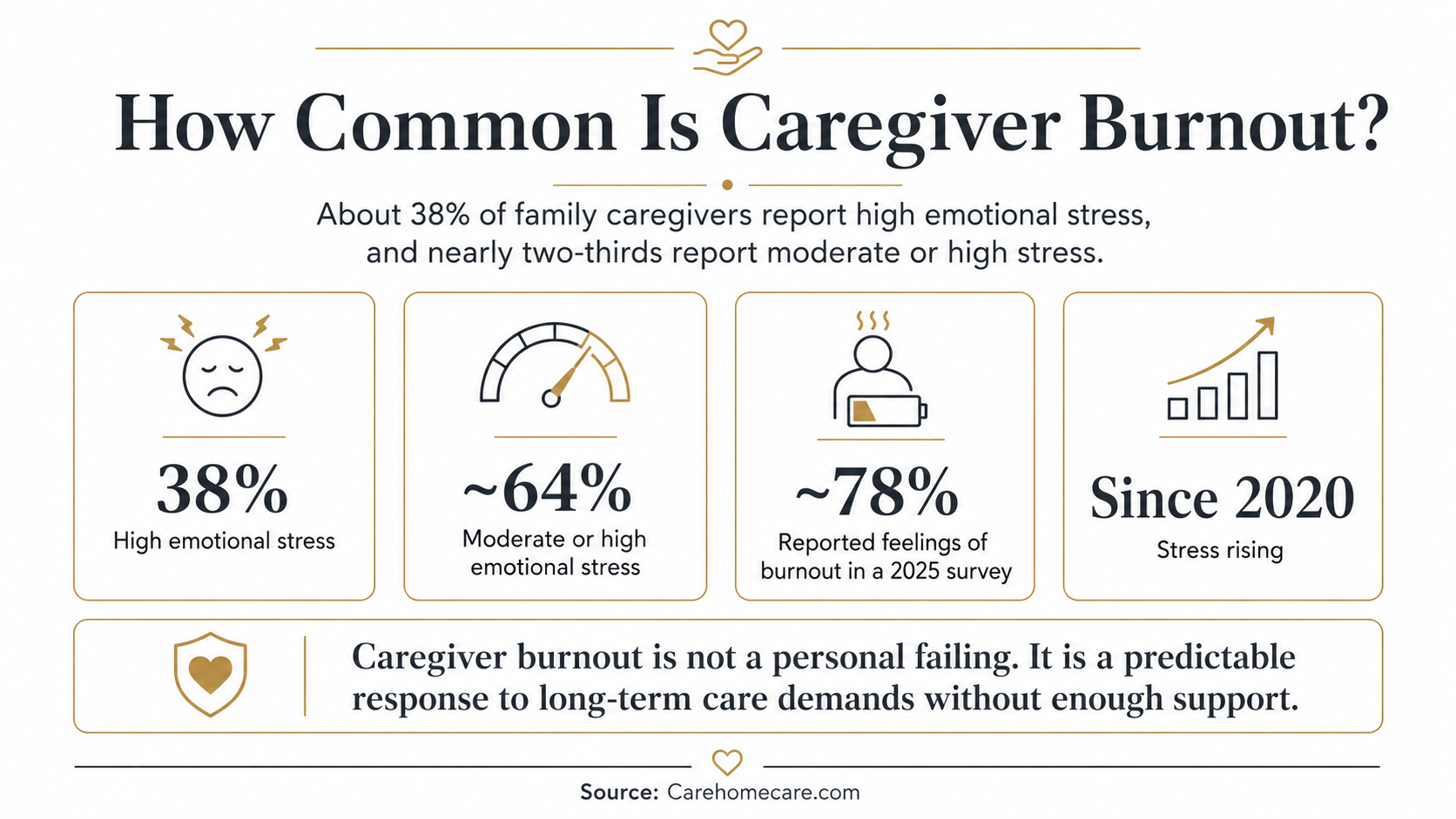
Caregiver burnout is common, with high emotional stress, rising burnout rates and growing evidence that long-term caregiving often takes a serious emotional toll.
What are the signs and symptoms of caregiver burnout and stress?
Because caregivers focus on someone else, they often miss the signals in themselves. Classic warning signs of caregiver stress include feeling burdened or worried all the time, frequent tiredness, sleeping too much or too little and losing interest in activities you used to enjoy.
As stress deepens into burnout, the signs get harder to ignore. Common ones include irritability or anger, sadness, changes in weight or appetite, frequent headaches or other pains, getting sick more often and using more alcohol or other substances to cope.
A telling red flag is self-neglect. Skipping your own medical appointments, abandoning hobbies and pulling away from friends all suggest the role has started to crowd out your own life.
| Category | Common signs |
| Emotional | Anxiety, sadness, irritability, feeling overwhelmed or hopeless |
| Physical | Fatigue, sleep changes, weight changes, headaches, getting sick more often |
| Behavioral | Withdrawing from activities, increased drinking or smoking, missing your own appointments |
What percentage of caregivers experience depression, anxiety or poor health?
The mental health toll is measurable. A 2025 umbrella review of dozens of studies put the median prevalence among informal caregivers at about 33% for depression and 35% for anxiety, with caregiver burden affecting close to half.
Physical health follows the same pattern. In the 2025 AARP and NAC report, 1 in 5 caregivers (20%) rated their health as fair or poor, and nearly 1 in 4 said they have trouble taking care of their own health while caring for someone else.
These rates hold fairly steady across gender and across different care recipients, which tells us the risk is tied to the caregiving role itself, not to any one type of caregiver.
| Caregiver mental and physical health | Share affected |
| Depression (median across studies) | ~33% |
| Anxiety (median across studies) | ~35% |
| Caregiver burden | ~49% |
| Fair or poor self-rated health | 20% |
| Difficulty caring for their own health | ~23% |

Caregiving stress is linked to depression, anxiety, burden and poorer self-rated health, making caregiver wellbeing an essential part of the care plan.
Do caregivers have a higher risk of death?
This question is wrapped in a lot of misinformation, so it is worth getting right. The famous figure comes from a 1999 study, which found that older spousal caregivers who reported emotional strain had a 63% higher risk of death over four years than non-caregivers.
But the same study found something just as important. Caregivers who provided care without feeling strained had no elevated mortality risk at all. In other words, it was the strain that mattered, not the act of caregiving.
Later and larger population studies went further. Caregivers, as a group, often have the same or lower mortality than non-caregivers.
So the viral claim that caregivers usually die before the person they care for is not supported by the evidence. The real lesson is that managing strain protects your health.
| What the research shows on caregiver mortality | Finding |
| Strained spousal caregivers (1999 study) | 63% higher 4-year mortality risk |
| Caregivers without strain | No elevated risk |
| Caregivers overall (later studies) | Often equal or lower mortality |
| “Caregivers usually die first” claim | Not supported by research |
How does caregiving affect physical and mental health?
The effects run in both directions. On the mental side, sustained caregiving stress raises the risk of depression and anxiety, and it chips away at sleep, focus and a person’s sense of self. The emotional load is often the part caregivers notice first.
The physical side is quieter but real. Chronic stress is linked to a weakened immune system, disrupted sleep and a higher long-term risk of conditions like heart disease and diabetes. Caregivers also report more frequent mental distress and chronic illness than non-caregivers.
There is a knock-on effect too. When a caregiver’s health slips, the quality of care they can provide slips with it, which is one more reason caregiver wellbeing is not a luxury but part of the care plan.
| Health area | How caregiving can affect it |
| Mental health | Higher depression and anxiety, loss of sleep and focus |
| Immune system | More frequent illness; chronic stress can weaken immunity |
| Long-term physical health | Greater risk of heart disease and diabetes |
| Self-care | Missed appointments, poorer diet and less activity |
How can caregivers prevent and recover from burnout?
The good news is that burnout responds to action. The most effective steps are practical: ask for and accept help, use respite care to get real breaks and join a support group so you are not carrying it alone.
Self-care does the rest of the work. Protecting your sleep, staying active, eating well and keeping your own medical appointments all blunt the effects of chronic stress. When sadness or anxiety lingers, talking with a mental health professional helps.
How long does recovery take? There is no fixed timeline. Burnout builds slowly, so it tends to ease slowly too. Recovery can take days, weeks or months depending on the person and situation, and the key variable is whether the underlying strain actually gets relieved.
| Recommended ways to prevent and ease burnout | Why it helps |
| Use respite care | Provides real breaks to recharge |
| Accept and delegate help | Spreads the load beyond one person |
| Join a support group | Reduces isolation and guilt |
| Prioritize sleep, food and exercise | Buffers the body against chronic stress |
| Talk to a professional | Addresses depression and anxiety early |
A note on support: Caregiver burnout is common and treatable, and reaching out is a sign of strength. The Caregiver Action Network and the Family Caregiver Alliance offer free guidance and local referrals. If you ever feel you are in crisis, you can call or text 988 at any time.
Sources & additional resources
- AARP and National Alliance for Caregiving. “Caregiving in the US 2025.” AARP Public Policy Institute.
- Cleveland Clinic. “Caregiver Burnout: What It Is, Symptoms and Prevention.” Cleveland Clinic.
- Mayo Clinic. “Caregiver Stress: Tips for Taking Care of Yourself.” Mayo Clinic.
- Soh, X.C., et al. “Prevalence of Depression, Anxiety, Burden, Burnout and Stress in Informal Caregivers: An Umbrella Review.” ScienceDirect.
- Schulz, R. and Beach, S.R. “Caregiving as a Risk Factor for Mortality: The Caregiver Health Effects Study.” JAMA (1999).
- Roth, D.L., et al. “Reduced Mortality Rates Among Caregivers: Does Family Caregiving Provide a Stress-Buffering Effect?.” PMC.
- National Academies of Sciences, Engineering, and Medicine. “Family Caregiving Roles and Impacts, in Families Caring for an Aging America.” NCBI Bookshelf.
- A Place for Mom. “Caregiver Burnout and Stress Statistics.” A Place for Mom.
- Caregiver Action Network. “Caregiver Action Network.” Caregiver Action Network.
- Family Caregiver Alliance. “Family Caregiver Alliance.” Family Caregiver Alliance.
- 988 Suicide & Crisis Lifeline. “988 Lifeline.” 988 Suicide & Crisis Lifeline.
For family caregivers feeling stretched, exhausted or unable to step away, CARE Homecare provides flexible respite-style home care across Los Angeles and Orange County. Caregivers can help with daily routines, mobility, meals, transportation, medication reminders and light housekeeping so families have time to rest and recover. CARE Homecare also offers companion care at home to support meaningful connection, reduce isolation and give family caregivers added relief.
Disclaimer: This article is for informational purposes only and is not medical, mental health, legal, financial or insurance advice. Caregiver stress, burnout, depression, anxiety, health risks and support needs can vary by person, care situation, diagnosis, family support, location and year. Families and caregivers should speak with qualified medical, mental health, care, legal, financial or insurance professionals before making care or health decisions.
Quick Scroll To:
- What is caregiver burnout, and how common is it?
- What are the signs and symptoms of caregiver burnout and stress?
- What percentage of caregivers experience depression, anxiety or poor health?
- Do caregivers have a higher risk of death?
- How does caregiving affect physical and mental health?
- How can caregivers prevent and recover from burnout?
- Sources & additional resources