
How many family caregivers are there in the US?

|
Updated: October 15th, 2026
|
Fact Checked
|
Cite this Research
Cite this research
APA
Gamburd, M. (2026, June 20). How many family caregivers are there in the US? CARE Homecare. https://carehomecare.com/research/family-caregiver-statistics
MLA
Gamburd, Moti. “How Many Family Caregivers Are There in the US?” CARE Homecare, 20 June 2026, https://carehomecare.com/research/family-caregiver-statistics.
Chicago
Gamburd, Moti. “How Many Family Caregivers Are There in the US?” CARE Homecare. Last modified June 20, 2026. https://carehomecare.com/research/family-caregiver-statistics.
Research highlights: A record 63 million Americans, about 1 in 4 adults, are family caregivers. The 59 million who care for an adult do unpaid work now valued at $1.01 trillion a year.
Among caregivers of adults, the typical caregiver is 51 years old, is a woman (61%) and provides 27 hours of care a week, often while holding a job. Many pay a real price: about $7,200 a year out of pocket.
Nearly 13 million care for someone with dementia, and 29% are squeezed between their own children and an adult with complex care needs.
Related research: How many seniors need long-term care? | How many home care workers are there? | How much does in-home care cost? | How is home care paid for?
How many family caregivers are there in the US?
The number is at an all-time high. 63 million Americans, roughly 1 in 4 adults, served as family caregivers in the past year.
That is a striking jump. The count rose by nearly 20 million caregivers, a 45% increase, in just one decade. Most of them, 59 million, care for an adult, while about 4 million care for a child under 18 with an illness or disability.
For the first time, the survey also counted paid family caregivers. About 11 million receive some compensation through Medicaid, the VA or state programs, though most still provide unpaid care on top of it.
| US family caregivers, 2025 | Number |
| Total family caregivers | 63 million |
| Caring for an adult | 59 million |
| Caring for a child with a disability or illness | 4 million |
| Paid family caregivers (Medicaid, VA, state) | 11 million |
| Increase since 2015 | +45% (nearly 20 million) |

A record 63 million Americans are family caregivers, marking an all-time high and a 45 percent increase since 2015.
What is the economic value of unpaid family caregiving?
It is staggering. Unpaid family caregiving was worth an estimated $1.01 trillion in 2024. That figure comes from 59 million caregivers providing 49.5 billion hours of care at an average value of $20.41 per hour.
To put it in perspective, that exceeds total federal, state and local Medicaid spending ($932 billion in 2024). It also represents work equal to nearly 24 million full-time jobs, about 17% of the entire US full-time workforce.
And it keeps climbing. The value has more than doubled in seven years, from $470 billion in 2017 to $600 billion in 2021 and past $1 trillion in 2024, driven by more caregivers, more hours and higher care costs.
| Economic value of unpaid family caregiving | Estimate |
| 2017 | $470 billion |
| 2021 | $600 billion |
| 2024 | $1.01 trillion |
| Hours of care (2024) | 49.5 billion |
| Average value per hour | $20.41 |
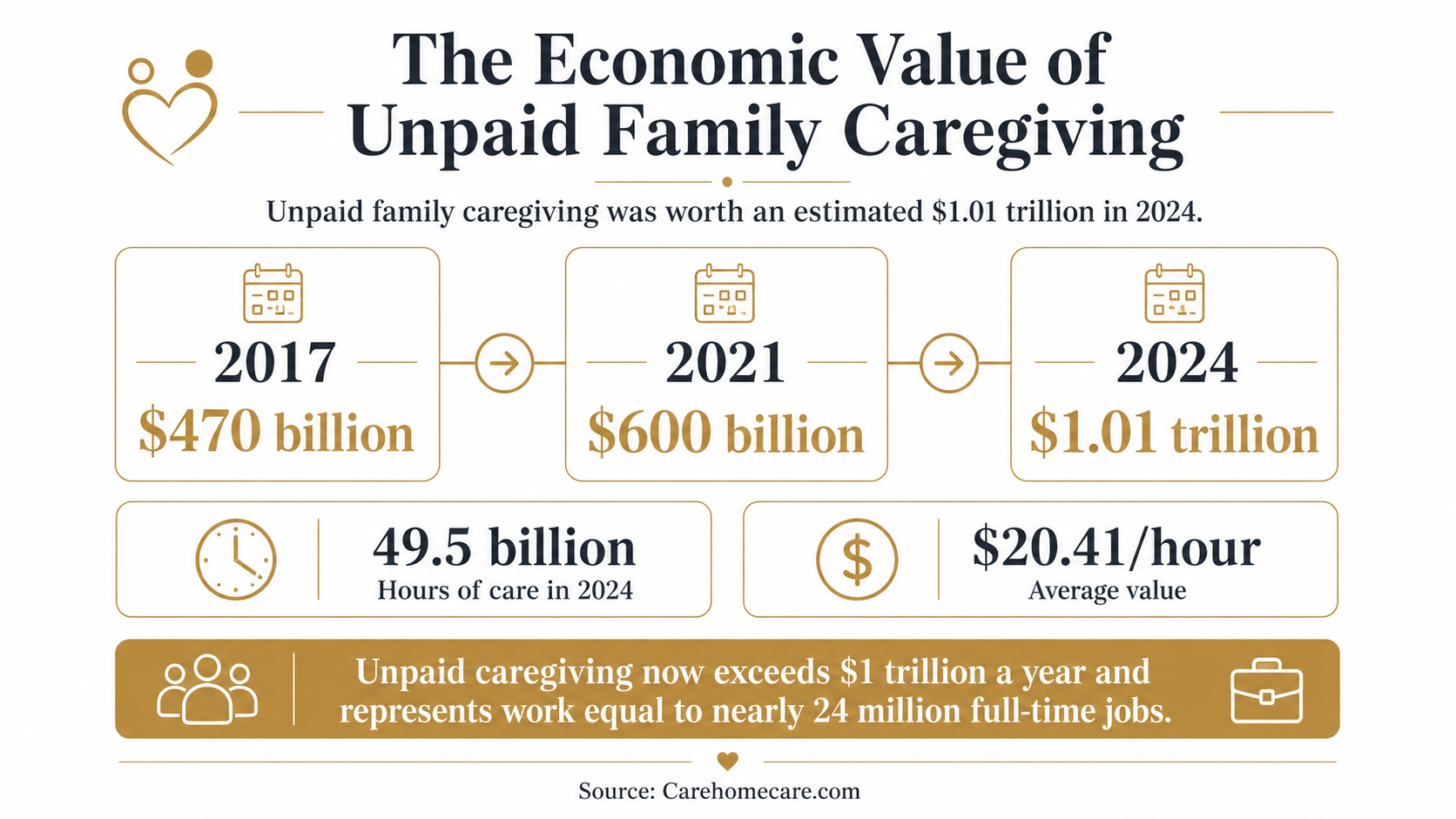
Unpaid family caregiving reached an estimated $1.01 trillion in economic value in 2024, representing 49.5 billion hours of care and work equal to nearly 24 million full-time jobs.
Who is the average family caregiver?
There is a clear profile. Among the 59 million who care for an adult, the average caregiver is 51 years old, and one in three is under 50.
61% are women and 38% are men, so caregiving still falls disproportionately on daughters, wives and sisters.
The time commitment is heavy. Caregivers provide an average of 27 hours of care per week, and nearly 1 in 4 (24%) give 40 or more hours, the equivalent of a full-time job, often unpaid or only partially paid.
Most do it while employed. 70% of working-age caregivers (under 65) hold a job, and half report work disruptions such as arriving late, cutting hours or taking leave.
The strain on careers and savings is one reason the paid home care workforce keeps growing.
| Profile of family caregivers of adults (2025) | Figure |
| Average age | 51 years |
| Women | 61% |
| Men | 38% |
| Average hours of care per week | 27 |
| Providing 40+ hours per week | 24% |
| Working-age caregivers who are employed | 70% |
What does family caregiving cost out of pocket?
Caregiving drains personal savings. The average family caregiver spent about $7,242 a year, roughly 26% of their income. Nearly eight in 10 caregivers reported routine caregiving costs.
The burden is uneven. Caregivers supporting someone with dementia spend more, about $8,978 a year, and caregivers with two or more work-related strains average $10,525. Housing and medical expenses make up the largest shares.
These are out-of-pocket dollars only. They do not count lost wages, reduced hours or forgone retirement savings, which push the true financial cost much higher for many families.
| Average annual out-of-pocket caregiving cost | Amount |
| All family caregivers | ~$7,200 |
| Caring for someone with dementia | ~$8,978 |
| Caregivers with two or more work-related strains | ~$10,525 |
| Share of caregiver income (average) | 26% |
How many caregivers support dementia patients or the sandwich generation?
Dementia caregiving is its own massive category. Nearly 13 million family members and friends provided more than 19 billion hours of unpaid care to people with Alzheimer’s and other dementias in 2025.
This care is more demanding and more costly than average.
Many caregivers also face pressure from two directions at once. 29% of family caregivers are part of the sandwich generation, caring for both children under 18 and an adult with disabilities or complex medical needs. That is roughly 18 million people stretched across two roles.
The squeeze is sharpest for younger caregivers. Among those under 50, 47% are juggling kids and adult care simultaneously, and the pattern is especially common in Latino and Black families.
| Dementia and sandwich generation caregivers | Figure |
| Dementia caregivers (US) | Nearly 13 million |
| Unpaid dementia care hours (yearly) | 19+ billion |
| Caregivers who are sandwich generation | 29% (~18 million) |
| Sandwich generation among caregivers under 50 | 47% |
Sources & additional resources
- AARP and National Alliance for Caregiving. “Caregiving in the US 2025.” AARP Public Policy Institute.
- AARP Public Policy Institute. “Valuing the Invaluable 2026: Family Caregivers’ Contribution Reaches $1 Trillion.” AARP.
- AARP. “2021 Caregiving Out-of-Pocket Costs Study.” AARP Public Policy Institute.
- National Alliance for Caregiving. “Caregiving in the US 2025 Report and Data Hub.” via John A. Hartford Foundation.
- Alzheimer’s Association. “2026 Alzheimer’s Disease Facts and Figures.” Alzheimer’s Association.
For families balancing work, children, aging parents and the demands of unpaid caregiving, CARE Homecare provides flexible at-home care support across Los Angeles and Orange County. Care plans can include help with daily routines, companionship, mobility, meals, transportation and medication reminders so family caregivers do not have to manage every task alone. For loved ones living with memory loss, CARE Homecare also offers specialized Alzheimer’s and dementia care at home focused on safety, familiarity and compassionate support.
Disclaimer: This article is for informational purposes only and is not medical, legal, financial, employment or insurance advice. Family caregiving needs, out-of-pocket costs, paid caregiver programs, dementia care needs and support options can vary by person, family situation, employer, program, location and year. Families should speak with qualified medical, care, legal, financial, employment or insurance professionals before making caregiving, payment or care-planning decisions.
Quick Scroll To: