
How do you get paid to care for a family member?

|
Updated: June 20, 2026
|
Fact Checked
|
Cite this Research
Cite this research
APA
Gamburd, M. (2026, June 20). How do you get paid to care for a family member? CARE Homecare. https://carehomecare.com/research/paid-family-caregiver-programs
MLA
Gamburd, Moti. “How Do You Get Paid to Care for a Family Member?” CARE Homecare, 20 June 2026, https://carehomecare.com/research/paid-family-caregiver-programs.
Chicago
Gamburd, Moti. “How Do You Get Paid to Care for a Family Member?” CARE Homecare. Last modified June 20, 2026. https://carehomecare.com/research/paid-family-caregiver-programs.
Research highlights: Yes, family members can often be paid to provide care, mainly through Medicaid and the VA. Medicaid self-directed programs typically pay family caregivers $13 to $25 an hour, depending on the state.
The VA’s primary caregiver stipend runs roughly $1,900 to $3,800 a month for eligible veterans’ caregivers. A separate model, structured family caregiving, pays a tax-free daily stipend in about 11 states. One important exception: Medicare does not pay family caregivers.
Related research: How is home care paid for? | Does Medicaid pay for home care? | How many family caregivers are there? | How much does in-home care cost?
This article is informational and not legal, tax or financial advice. Program rules, pay rates and eligibility vary by state and change often; confirm current details with the relevant agency before acting.
Can a family member get paid to be a caregiver?
In many cases, yes. If you are caring for an aging parent, a spouse or another relative, several programs can pay you for that work. The two biggest pathways are Medicaid and the Department of Veterans Affairs, with a handful of other options depending on your situation.
The catch is that payment almost always depends on the care recipient’s eligibility, not yours. Your loved one generally has to qualify for Medicaid or be a veteran with qualifying needs, and the care usually has to rise to a level that would otherwise require a paid aide or facility.
One program that does not help here is Medicare. It pays for skilled home health through certified agencies, but it does not pay family members to provide personal care. We cover the main paths below.
| Main ways to get paid as a family caregiver | Who it is for |
| Medicaid self-directed care | Caring for a Medicaid-eligible relative |
| Structured family caregiving (Medicaid) | Live-in caregivers in about 11 states |
| VA caregiver stipend (PCAFC) | Caring for an eligible veteran |
| Veteran-Directed Care | Veterans managing their own care budget |
| Long-term care insurance | Policyholders with cash or family-care benefits |
How much does Medicaid pay family caregivers per hour?
Medicaid is the largest payer of home care and the main public pathway for paid family caregiving. Published caregiver-pay summaries generally put Medicaid family caregiver pay around $13 to $25 an hour, but rates vary by state, county, program and approved care plan.
Medicaid-specific rate reporting is not always transparent.
The big self-directed programs show the spread. California’s In-Home Supportive Services (IHSS) averages around $18.50 an hour, New York’s CDPAP runs roughly $16 to $23, and lower-cost states like Missouri and Texas often sit closer to $12 to $18.
There is also a tax wrinkle worth knowing. Under the IRS difficulty-of-care rule, Medicaid payments to a caregiver who lives in the same home as the recipient can sometimes be excluded from taxable income, so ask a tax professional about your situation.
| Example Medicaid family caregiver pay rates (2025) | Hourly |
| National range | $13 to $25 |
| California (IHSS) | ~$16 to $21 (avg ~$18.50) |
| New York (CDPAP) | ~$16 to $23 |
| Texas (STAR+PLUS, CFC) | ~$12 to $18 |
| Missouri (Consumer Directed Services) | ~$12 to $17 |
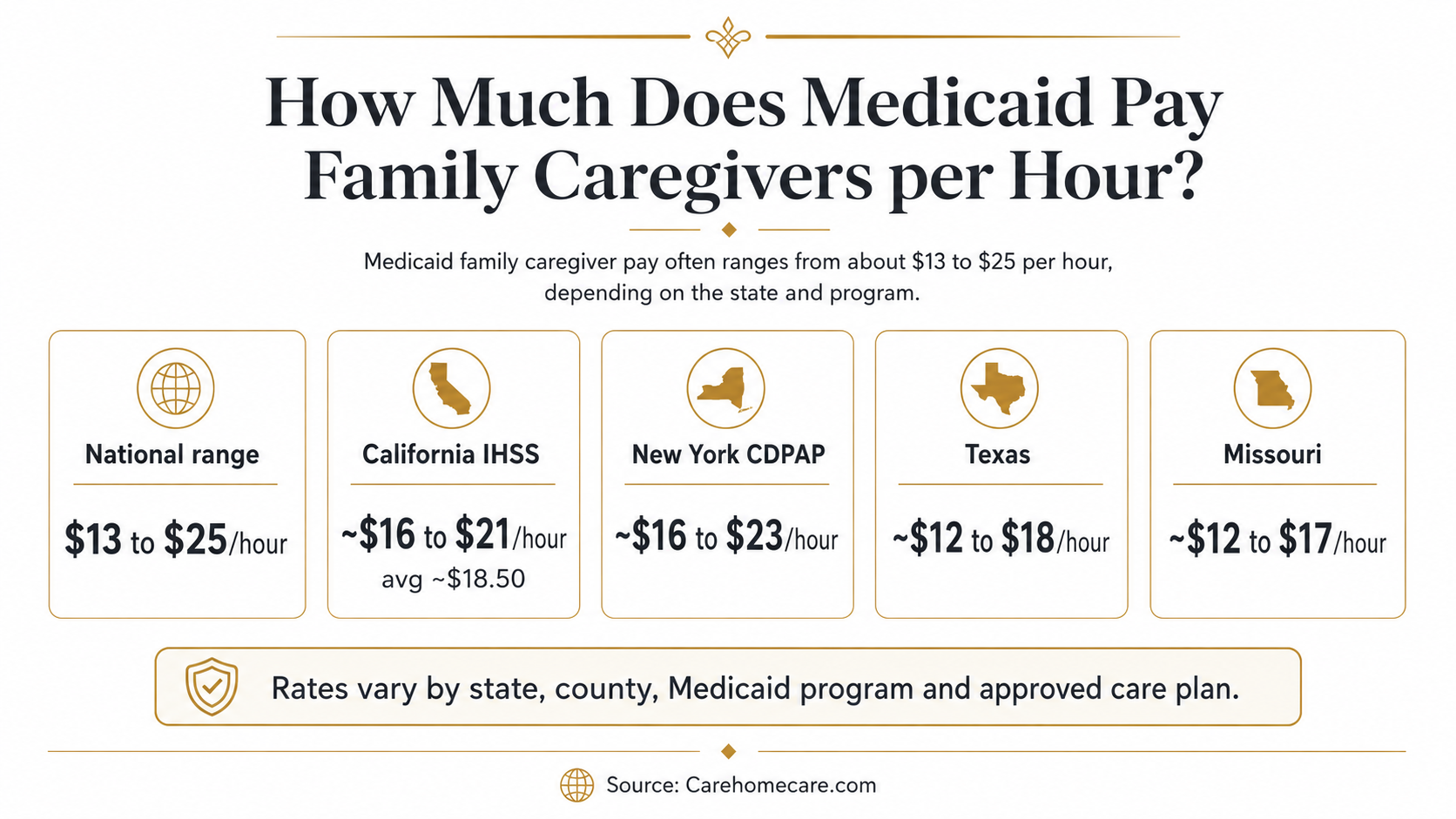
Medicaid family caregiver pay often ranges from about $13 to $25 per hour, but actual rates vary by state, county, program and approved care plan.
How do Medicaid self-directed and structured family caregiving programs work?
There are two main models. In self-directed, also called consumer-directed, programs, your Medicaid-eligible relative gets a care budget and can hire, train and pay the caregiver of their choice, including a family member.
New York’s CDPAP, California’s IHSS and Wisconsin’s IRIS all work this way.
The second model is structured family caregiving (SFC). Here a caregiver lives with the recipient and receives a tax-free daily stipend, with the family caregiver typically getting $40 to $70 a day. It is available in about 11 states, including Georgia, Indiana and Connecticut.
Can you be paid to care for a spouse? Sometimes. Most states let you pay relatives, but fewer allow paying legally responsible relatives such as spouses or parents of minor children. Several self-directed and structured programs do permit it, so the answer depends on your state.
| Two Medicaid family caregiver models | How it pays |
| Self-directed care (CDPAP, IHSS, IRIS) | Hourly wage; relative hires you directly |
| Structured family caregiving (SFC) | Tax-free daily stipend (~$40 to $70/day to caregiver) |
| SFC availability | ~11 states |
| Paying a spouse | Allowed in some states and programs, not all |
How much does the VA pay family caregivers, and who qualifies?
Veterans’ caregivers have a dedicated benefit: the Program of Comprehensive Assistance for Family Caregivers (PCAFC). It pays a primary family caregiver a tax-free monthly stipend.
Using the VA’s GS-4 Step 1 formula and the 2026 OPM locality pay tables, that stipend works out to roughly $1,900 to $3,800 a month, depending on the veteran’s location and care level.
The math is set by formula. The VA uses the federal GS-4, Step 1 pay rate for the veteran’s area, then pays either 62.5% (Level One) or 100% (Level Two) of that monthly amount based on how much help the veteran needs.
Only the designated primary caregiver receives this stipend. A secondary caregiver may get supports such as training, counseling and certain travel benefits, but not the monthly payment.
To qualify, the veteran must have a serious service-connected condition rated 70% or higher, need personal care for at least six months and be enrolled in VA health care.
The caregiver must be 18 or older, and unlike VA Aid and Attendance, a spouse can be paid. Veterans of all service eras are now eligible.
| VA PCAFC caregiver stipend (2026) | Detail |
| Monthly stipend range | ~$1,900 to $3,800 (tax-free) |
| Level One | 62.5% of local GS-4 monthly rate |
| Level Two | 100% of local GS-4 monthly rate |
| Veteran disability rating needed | 70% or higher (service-connected) |
| Extra benefits | CHAMPVA coverage (if not otherwise insured), 30+ days respite, training |

The VA PCAFC stipend can provide roughly $1,900 to $3,800 per month for eligible primary family caregivers, along with added benefits like CHAMPVA, respite and training.
Can Medicare or long-term care insurance pay family caregivers?
Medicare is the common misconception. It does not pay family caregivers. Medicare covers doctor-ordered skilled home health from certified agencies, not personal care provided by a relative.
Some Medicare Advantage plans may offer limited supplemental supports, but Medicare itself does not pay a family caregiver’s wage.
Long-term care insurance is more flexible, but it depends on the policy. Some cash or indemnity policies pay a set benefit you can use however you like, including paying a family member.
Traditional reimbursement policies usually require a licensed agency, though a few allow family care.
The takeaway: read the policy or call the insurer. If your loved one holds a long-term care policy, ask specifically whether it covers care from a family member and what documentation it requires.
| Will it pay a family caregiver? | Answer |
| Medicare | No |
| Medicare Advantage | Sometimes limited supports, not a wage |
| Long-term care insurance (cash/indemnity) | Often yes |
| Long-term care insurance (reimbursement) | Sometimes, varies by policy |
Which states pay family caregivers the most?
Medicaid-specific family caregiver pay is hard to compare across states because rates vary by program, county, managed care plan and approved care hours.
General in-home caregiver wage data suggest higher-cost states such as Washington, California, Massachusetts, Colorado and New York often sit near the top of the range, but actual Medicaid family caregiver pay may differ.
Lower-cost states pay less. Many southern and rural states fund family caregiving closer to $12 to $15 an hour, reflecting local pay scales and tighter Medicaid budgets.
One caution for planning: home and community-based services are optional under federal Medicaid law, so availability and rates can shift with state and federal budgets. Check your state’s current program before counting on a specific rate.
| General caregiver pay benchmarks by state tier | Typical hourly |
| Higher-paying states (WA, CA, NY, MA, CO) | ~$18 to $26 |
| Mid-range states | ~$15 to $18 |
| Lower-paying states (many southern/rural) | ~$12 to $15 |
Sources & additional resources
- KFF. “Medicaid’s Home Care Support for Family Caregivers in 2025.” KFF.
- U.S. Department of Veterans Affairs. “Program of Comprehensive Assistance for Family Caregivers.” VA.gov.
- U.S. Department of Veterans Affairs. “Monthly Stipend for Primary Family Caregivers Fact Sheet.” VA Caregiver Support Program.
- American Council on Aging. “Medicaid Structured Family Caregiving: Benefits and Eligibility.” Medicaid Planning Assistance.
- National Academy for State Health Policy. “Medicaid Structured Family Caregiving.” NASHP.
- GoodRx. “The States That Pay Family Caregivers Through Medicaid.” GoodRx.
- Paid Care. “Medicaid Programs That Pay Family Caregivers.” Paid.Care.
- Internal Revenue Service. “Certain Medicaid Waiver Payments May Be Excludable From Income.” IRS.
- U.S. Office of Personnel Management. “2026 General Schedule (GS) Locality Pay Tables.” OPM.gov.
- USAGov. “Get Paid as a Caregiver for a Family Member.” USAGov.
- A Place for Mom. “Using Long-Term Care Insurance to Pay for Home Care.” A Place for Mom.
Family caregivers often provide the daily support that keeps a loved one safe at home, but paid family caregiver programs do not always cover every hour or task. CARE Homecare helps families across Los Angeles and Orange County add flexible professional care at home when extra help is needed with bathing, mobility, meals, companionship and medication reminders. Families who want relief from the daily emotional and social demands of caregiving can also explore CARE Homecare’s companion care support for meaningful connection and practical help at home.
Disclaimer: This article is for informational purposes only and is not medical, legal, tax, financial, employment or benefits advice. Medicaid, VA, state caregiver programs, long-term care insurance rules, pay rates, tax treatment and eligibility requirements can vary by state, program, payer, policy, care needs and year. Families should speak with the relevant agency, health plan, tax professional, attorney, financial professional or another qualified professional before making caregiving, payment or benefits decisions.
Quick Scroll To:
- Can a family member get paid to be a caregiver?
- How much does Medicaid pay family caregivers per hour?
- How do Medicaid self-directed and structured family caregiving programs work?
- How much does the VA pay family caregivers, and who qualifies?
- Can Medicare or long-term care insurance pay family caregivers?
- Which states pay family caregivers the most?
- Sources & additional resources