
Contents
ADL / IADL Checklist for Seniors | Free Printable Assessment (PDF Download)
A free printable assessment covering all ADLs and IADLs so families can clearly see where an elderly loved one needs support and what kind of care would help most.
Download or Print the ADL and IADL Assessment Checklist
Most families do not realize how much has changed until something goes wrong. A fall. A missed diagnosis. A financial decision that does not make sense. By the time the crisis arrives, the signs were there for months. This checklist gives you a structured, objective way to see what is actually happening before things reach that point.
It covers all six basic activities of daily living and all eight instrumental activities of daily living, with a simple three-column rating scale any family member can use without clinical training. The notes field on each row captures the context that a checkbox alone cannot.
It is designed for adult children assessing a parent for the first time, family caregivers tracking changes over time, and anyone preparing for a conversation with a physician, care manager, or home care agency.
Tip: Complete the assessment in the morning when cognition is typically sharpest, do it together with your loved one where possible, and save a dated copy each time you reassess so you have a record of change over time.
You notice that your mother has been wearing the same blouse for four days. The kitchen has a carton of milk that expired a week ago. The stack of unopened mail on the counter keeps growing. She seems fine when you visit. She says she is fine. But something feels off, and you cannot quite name it.
What you are observing is not random. It is a pattern. And it has a name: a decline in activities of daily living and instrumental activities of daily living, referred to in care settings as ADLs and IADLs. These are the concrete, measurable tasks that make independent living possible, and they are among the first things to slip when an older adult’s health, cognition, or mobility begins to change.
This page gives families and caregivers a structured way to assess where a loved one stands today. It explains what ADLs and IADLs are, why the assessment matters, what early warning signs to watch for, and how to use the results to make informed decisions about care. The free printable ADL and IADL checklist is available for download below.
For a deeper explanation of these terms and how they are used in care planning, see our companion article on what ADLs and IADLs are.
In-home care support across Los Angeles and Orange County by CARE Homecare
An ADL and IADL assessment tells you where the gaps are. Professional caregivers help fill them. CARE Homecare provides flexible non-medical in-home care throughout Los Angeles and Orange County, built around each person’s specific functional needs and daily routine.
If your loved one is struggling with ADLs or IADLs, see what home care providers do for a plain-language breakdown of what non-medical caregiving actually covers day to day.

What Are ADLs and IADLs?
Activities of daily living are the foundational self-care tasks a person needs to perform to maintain basic physical functioning. The six core ADLs, as defined by the widely used Katz Index of Independence in Activities of Daily Living, are bathing, dressing, toileting, transferring (moving from one position to another), continence, and feeding. These are the tasks most closely tied to physical safety and personal dignity.
Instrumental activities of daily living are a step up in complexity. They require cognitive ability, planning, and often the use of external systems or tools. The eight domains measured by the Lawton-Brody Instrumental Activities of Daily Living Scale, developed in 1969 and still widely used today, are telephone use, shopping, food preparation, housekeeping, laundry, mode of transportation, responsibility for own medications, and handling finances.
The distinction matters for several reasons. IADLs typically decline before ADLs. A person may still be able to dress and bathe independently while quietly losing their ability to manage a checkbook, keep a stocked refrigerator, or remember to refill a prescription. That gap between what looks fine on the surface and what is actually slipping is exactly what this assessment is designed to catch.
Both the Katz ADL Scale and the Lawton-Brody IADL Scale are recognized assessment frameworks used by care managers, physicians, social workers, hospital discharge planners, and long-term care insurance providers. While the formal versions of these scales are used in clinical settings, the checklist on this page is designed to give families a practical, accessible version of the same assessment they can use at home.
Why Assessing ADLs and IADLs Matters
The results of an ADL and IADL assessment do more than confirm what a family already suspects. They translate subjective observations into structured information that can be acted on. Here is what that information is actually used for.
Determining care needs and appropriate support level. Understanding which tasks a person can no longer do independently makes it possible to identify exactly what kind of help is needed. That might mean a few hours of companionship and errand support per week, or it might mean daily personal care assistance and around-the-clock supervision. The checklist helps families move from vague concern to specific, actionable planning.
Establishing eligibility for services and benefits. ADL and IADL assessments are used to determine eligibility for Medicaid home and community-based services, long-term care insurance benefits, and in some cases, Department of Veterans Affairs (VA) care programs. Many of these programs require documented evidence that a person needs help with a specific number of ADLs. Completing and keeping a record of this assessment gives families documentation they may need later.
Supporting the conversation with a physician or care manager. Families often struggle to communicate the scope of a loved one’s decline to a doctor who sees them for fifteen minutes every few months. A completed ADL and IADL checklist gives that conversation structure. It translates anecdotal observations into a documented functional profile.
Making the case for home care. For families who are debating whether home care is premature, an ADL and IADL assessment provides an objective basis for that decision. It removes the guesswork and, just as importantly, it removes the emotional charge from a conversation that is often fraught for everyone involved.

Early Warning Signs to Watch For
Before sitting down with a formal checklist, most families notice something. The following signs are the human version of an ADL and IADL assessment: what you observe before you formally evaluate. None of these alone is cause for alarm, but a pattern of two or more warrants a closer look.
Personal hygiene changes. Wearing the same clothing for several days, body odor that is unusual for the person, unkempt hair, or dental hygiene that appears neglected. These are among the earliest and most visible signs that bathing and dressing, two core ADLs, are becoming difficult.
Kitchen and nutrition concerns. Expired food in the refrigerator, a pantry that is nearly empty, evidence that meals are not being prepared regularly, or noticeable weight loss. Food preparation is an IADL, and difficulty with it can quickly lead to malnutrition and dehydration, two of the most common and preventable health problems in elderly adults living at home.
Household disorder. A home that has become cluttered, unclean, or disorganized in ways that were not typical for that person. Piles of unopened mail, unwashed dishes, or laundry that has accumulated are all observable indicators of IADL decline.
Medication confusion. Pills left in the organizer at the wrong time, multiple partially used bottles of the same prescription, or a person who cannot reliably describe what they take and when. Managing medications is a complex IADL, and errors in this area carry direct health consequences.
Difficulty with technology and communication. Trouble using a phone, confusion about how to make calls, or missed check-ins that were previously reliable can indicate cognitive decline affecting IADL function.
Financial indicators. Unopened bills, late payment notices, confusion about recent transactions, or evidence that financial decisions are being made impulsively or without understanding. Managing finances is among the most cognitively demanding IADLs and is often one of the first to show strain.
Driving concerns. New dents or scratches on the vehicle, getting lost on familiar routes, or feedback from others about driving behavior. Transportation is both a practical IADL and a safety issue that often requires a direct conversation.
Missed appointments. A pattern of forgetting or confusing scheduled visits with physicians, family members, or services.

ADL and IADL Checklist for Seniors (Free Printable PDF)
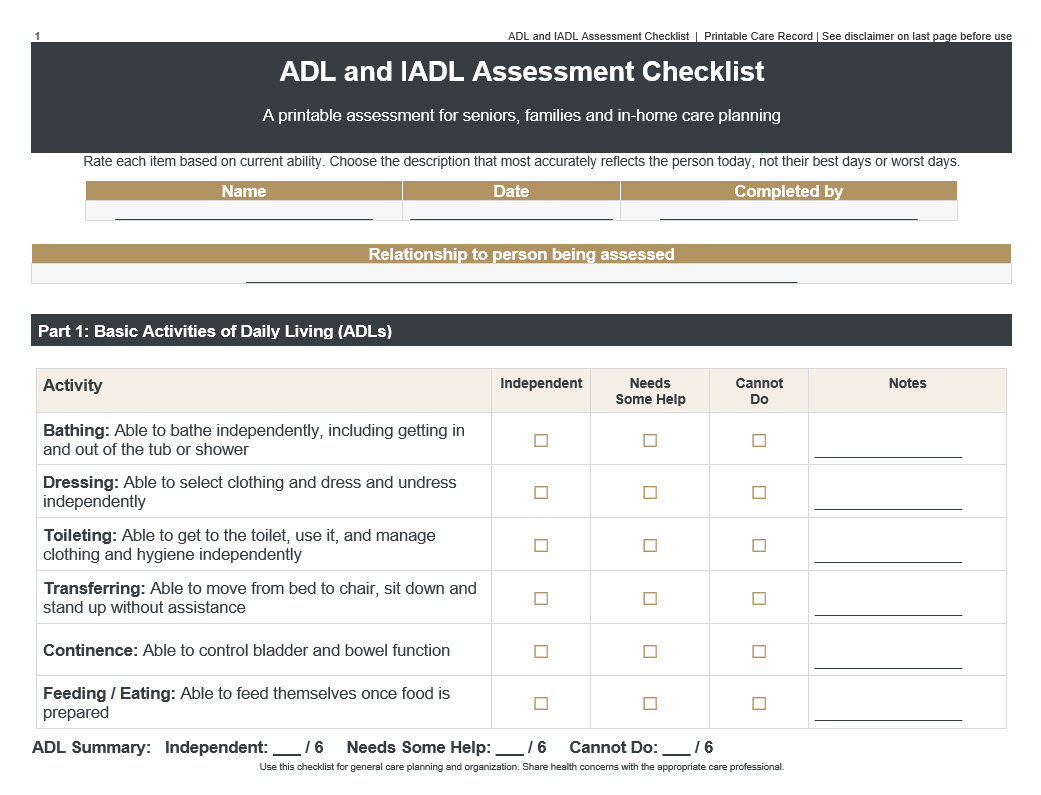
The checklist below covers all six core ADLs and all eight IADLs from the Lawton-Brody framework, adapted for family use. For each item, mark the column that most accurately describes your loved one’s current ability. Use the notes field to record any relevant observations.
ADL and IADL Assessment Checklist
Name: _______________ Date: _______________ Completed by: _______________
Relationship to person being assessed: _______________
Part 1: Basic Activities of Daily Living (ADLs)
Rate each item based on current ability. Choose the description that most accurately reflects the person today, not their best days or worst days.
- Bathing: Able to bathe independently, including getting in and out of the tub or shower
Independent: ☐ Needs Some Help: ☐ Cannot Do: ☐ Notes: _______________ - Dressing: Able to select clothing and dress and undress independently
Independent: ☐ Needs Some Help: ☐ Cannot Do: ☐ Notes: _______________ - Toileting: Able to get to the toilet, use it, and manage clothing and hygiene independently
Independent: ☐ Needs Some Help: ☐ Cannot Do: ☐ Notes: _______________ - Transferring: Able to move from bed to chair, sit down and stand up without assistance
Independent: ☐ Needs Some Help: ☐ Cannot Do: ☐ Notes: _______________ - Continence: Able to control bladder and bowel function
Independent: ☐ Needs Some Help: ☐ Cannot Do: ☐ Notes: _______________ - Feeding / Eating: Able to feed themselves once food is prepared
Independent: ☐ Needs Some Help: ☐ Cannot Do: ☐ Notes: _______________
ADL Summary: Independent: ___ / 6 Needs Some Help: ___ / 6 Cannot Do: ___ / 6
Part 2: Instrumental Activities of Daily Living (IADLs)
- Using the telephone: Able to look up numbers, dial, and use the phone independently
Independent: ☐ Needs Some Help: ☐ Cannot Do: ☐ Notes: _______________ - Shopping: Able to plan and complete grocery or personal shopping independently
Independent: ☐ Needs Some Help: ☐ Cannot Do: ☐ Notes: _______________ - Food preparation: Able to plan and prepare meals independently
Independent: ☐ Needs Some Help: ☐ Cannot Do: ☐ Notes: _______________ - Housekeeping: Able to maintain the home at a safe, livable standard
Independent: ☐ Needs Some Help: ☐ Cannot Do: ☐ Notes: _______________ - Laundry: Able to wash, dry, and put away clothing and linens independently
Independent: ☐ Needs Some Help: ☐ Cannot Do: ☐ Notes: _______________ - Transportation: Able to drive or arrange independent transportation
Independent: ☐ Needs Some Help: ☐ Cannot Do: ☐ Notes: _______________ - Managing medications: Able to manage own prescriptions, refills, and dosing schedule
Independent: ☐ Needs Some Help: ☐ Cannot Do: ☐ Notes: _______________ - Managing finances: Able to handle banking, bill payment, and financial decisions
Independent: ☐ Needs Some Help: ☐ Cannot Do: ☐ Notes: _______________
IADL Summary: Independent: ___ / 8 Needs Some Help: ___ / 8 Cannot Do: ___ / 8
Overall Observations and Notes
___________________________________________________________________________
___________________________________________________________________________
___________________________________________________________________________
Completed by: _______________ Date: ___________ Next review date: ____________
How to Use This Checklist
This assessment works best when approached as a conversation, not an evaluation. Sitting down with your loved one and working through the checklist together, where cognitive ability allows, is more respectful and often more accurate than completing it from the outside. When someone feels involved in their own assessment rather than assessed, they are more likely to be candid about what is difficult.
A few practical guidelines for getting the most accurate and useful result:
Do it in the morning. Many older adults, particularly those with early cognitive changes, have sharper cognition and more energy in the morning hours. An assessment completed midday or in the evening when fatigue has set in may underrepresent their actual ability.
Rate current ability, not potential. The question is not whether they could do this task on a good day, but whether they reliably do it now. A person who could theoretically manage their medications but consistently misses doses is not fully independent in that area.
Include other family members. Different people observe different things. A sibling who visits less frequently may notice changes that have become invisible to the primary caregiver through familiarity. A care manager or the person’s physician can also provide valuable input.
Do not treat declining scores as failure. Functional decline is a normal and expected part of aging for many people. The purpose of this checklist is not to judge, but to inform. A lower score today than three months ago is not a bad outcome from the assessment. It is useful information that points toward what kind of support would help.
Reassess regularly. The Katz ADL Scale and Lawton-Brody IADL Scale are designed to track change over time, not just establish a baseline. Completing this checklist monthly, or whenever there is a significant change such as a hospitalization, a fall, a new diagnosis, or a medication change, gives families a running record that is valuable for care planning and medical conversations.

When a Daily Checklist Is Not Enough
The checklist results give you a functional picture of your loved one’s current independence. Here is how to interpret what you are seeing.
Difficulty with one to two IADLs only, all ADLs intact. This typically suggests that the person is managing most of daily life independently but is beginning to struggle with the more complex tasks of independent living. The most common areas at this stage are finances, transportation, and medication management. Light support, a few hours a week of companionship, errand assistance, and medication reminders, can make a meaningful difference without significantly changing the person’s sense of independence.
Difficulty with three or more IADLs, or one to two ADLs. This level of functional difficulty suggests that daily life is becoming genuinely hard to manage alone. Meal preparation may be inconsistent, the home may be falling behind, and personal care tasks are beginning to require assistance. This is the range where consistent non-medical home care, several hours per day or a structured schedule of weekly visits, typically becomes appropriate.
Difficulty with three or more ADLs. When the foundational tasks of daily self-care, bathing, dressing, toileting, and transferring, are regularly requiring assistance, the person likely needs consistent daily caregiver support. Depending on the pattern of need, this may mean full-time daytime care, overnight support, or 24-hour home care. Safety becomes the primary concern at this level, particularly around falls and mobility.
It is worth noting that the ADL and IADL profile does not tell the whole story. Cognitive status, the availability of family support, the safety of the home environment, and the person’s own preferences all factor into the care decision. Our home safety checklist for seniors is a useful companion assessment for evaluating the physical safety of the living environment alongside functional ability.
How Non-Medical Home Care Supports ADL and IADL Needs
Non-medical home care is specifically designed to support the tasks captured in this checklist. Here is how professional caregivers address each area.
For basic ADLs, non-medical caregivers provide bathing assistance, help with dressing and grooming, toileting support and incontinence care, and transfer and mobility assistance. These are hands-on personal care tasks that require consistency, patience, and an understanding of each person’s preferences and physical limitations. Our caregivers are trained to support these tasks while preserving dignity and fostering as much independence as the person can safely maintain.
For IADLs, non-medical home care covers meal planning and preparation, light housekeeping and laundry, transportation to appointments and errands, grocery shopping, and medication reminders. On the medication reminder point specifically: non-medical caregivers prompt the person to take their medications at the scheduled time and observe and log that they have done so. They do not administer medications in a clinical sense. If medication management needs exceed this scope, a licensed home health provider is required.
There are important tasks within the IADL framework that fall outside the scope of non-medical home care. Managing finances and making banking decisions are outside the caregiver’s role. Complex medical monitoring, wound care, IV management, and injections require a licensed home health agency or skilled nursing provider. When families ask about the boundaries of non-medical care, we are always direct about scope, because clarity protects the person receiving care.
If the ADL and IADL assessment reveals a pattern of need that aligns with what professional caregivers provide, our daily caregiver checklist for elderly adults shows exactly how those tasks are organized and tracked on a day-to-day basis.
When to Call a Home Care Agency
If your loved one is struggling with two or more ADLs, or finding three or more IADLs genuinely difficult to manage, it is worth having a conversation with a professional home care agency. Not because the decision has already been made, but because having accurate information about what is available and what it costs makes the decision easier to make on your own terms, before a crisis forces it.
Most families who call us are not in crisis. They are ahead of it. They noticed the signs, completed an assessment, and decided they wanted to understand their options while there was still time to plan thoughtfully. That is the right approach.
CARE Homecare serves families in Los Angeles and Orange County with non-medical in-home care built around each person’s specific ADL and IADL profile. To speak with someone about your loved one’s needs, contact us for a free 15-minute consultation. We will help you understand what level of support makes sense and what a care plan built around their actual functional needs looks like.
Talk with our team about care options that fit your loved one’s actual daily needs, whether that means a few hours of support each week or full-time coverage.
Address: 1156 North Gardner Street, West Hollywood, CA 90046
Telephone: (323) 851-1422
Email: info@carehomecare.com

Sources
- Katz S, Downs TD, Cash HR, Grotz RC. “Progress in development of the index of ADL.” The Gerontologist. 1970;10(1):20–30. https://pubmed.ncbi.nlm.nih.gov/5420677/
- Lawton MP, Brody EM. “Assessment of older people: self-maintaining and instrumental activities of daily living.” The Gerontologist. 1969;9(3):179–186. https://pubmed.ncbi.nlm.nih.gov/5349366/
- Edemekong PF, Bomgaars DL, Sukumaran S, Schoo C. “Activities of Daily Living.” StatPearls. National Center for Biotechnology Information. Updated June 26, 2023. https://www.ncbi.nlm.nih.gov/books/NBK470404/
- Graf CL. “The Lawton Instrumental Activities of Daily Living Scale.” AJN, American Journal of Nursing. 2008;108(4):52–62. doi:10.1097/01.NAJ.0000314810.46029.74. https://pubmed.ncbi.nlm.nih.gov/18367931/
- Hartford Institute for Geriatric Nursing, NYU Rory Meyers College of Nursing. “Try This: Best Practices in Nursing Care to Older Adults — The Lawton Instrumental Activities of Daily Living (IADL) Scale.” ConsultGeri Try This Series. https://hign.org/sites/default/files/2020-06/Try_This_General_Assessment_23.pdf
- Buurman BM, Alonso-Coello P, Thomsen T, et al. “Activities of daily living in older community-dwelling persons: a systematic review of psychometric properties of instruments.” Age and Ageing. 2019;48(5). https://www.ncbi.nlm.nih.gov/pmc/articles/PMC6589141/
Related Resources
- What Are ADLs and IADLs? | The complete guide to understanding functional assessment terminology
- Free Printable Caregiver Daily Checklist for Elderly | Track daily care tasks and observations with our printable care log
- Home Safety Checklist for Seniors | Assess the physical safety of your loved one’s home environment
- Types of Home Care | Understand the difference between non-medical home care and home health care
- What Do Home Care Providers Do? | A plain-language breakdown of non-medical caregiver responsibilities
Disclaimer: The information on this page is intended for general educational purposes only and does not constitute medical, legal, or professional care advice. The ADL and IADL checklist provided here is adapted for family use and is not a substitute for a formal clinical assessment by a licensed healthcare provider. Results should be shared with the person’s physician or a qualified care professional before making care decisions. CARE Homecare provides non-medical home care services only. If you have concerns about a loved one’s health, safety, or cognitive status, please consult a qualified medical professional.
 https://carehomecare.com/wp-content/uploads/2026/05/Post-Surgery-Home-Care-Checklist-Non-Medical-Support-for-Recovery-at-Home-Free-PDF-and-Word-Download.jpg
839
1315
Moti Gamburd
https://a81019caredemo.wpengine.com/wp-content/uploads/2019/08/CARE-Homecare-Logo-wht.png
Moti Gamburd2026-05-14 20:03:392026-05-14 20:03:39Free Post-Surgery Home Care Checklist | Non-Medical Support for Recovery at Home | PDF or Word Print or Download
https://carehomecare.com/wp-content/uploads/2026/05/Post-Surgery-Home-Care-Checklist-Non-Medical-Support-for-Recovery-at-Home-Free-PDF-and-Word-Download.jpg
839
1315
Moti Gamburd
https://a81019caredemo.wpengine.com/wp-content/uploads/2019/08/CARE-Homecare-Logo-wht.png
Moti Gamburd2026-05-14 20:03:392026-05-14 20:03:39Free Post-Surgery Home Care Checklist | Non-Medical Support for Recovery at Home | PDF or Word Print or Download https://carehomecare.com/wp-content/uploads/2026/05/Home-Care-Supplies-Preparation-Checklist.jpg
842
1316
Moti Gamburd
https://a81019caredemo.wpengine.com/wp-content/uploads/2019/08/CARE-Homecare-Logo-wht.png
Moti Gamburd2026-05-14 18:49:452026-05-14 18:49:45Home Care Supplies Checklist | What to Have Ready Before Care Starts | Free Printable PDF
https://carehomecare.com/wp-content/uploads/2026/05/Home-Care-Supplies-Preparation-Checklist.jpg
842
1316
Moti Gamburd
https://a81019caredemo.wpengine.com/wp-content/uploads/2019/08/CARE-Homecare-Logo-wht.png
Moti Gamburd2026-05-14 18:49:452026-05-14 18:49:45Home Care Supplies Checklist | What to Have Ready Before Care Starts | Free Printable PDF https://carehomecare.com/wp-content/uploads/2026/05/Light-Housekeeping-Checklist-for-Home-Caregivers-1.jpg
832
1080
Moti Gamburd
https://a81019caredemo.wpengine.com/wp-content/uploads/2019/08/CARE-Homecare-Logo-wht.png
Moti Gamburd2026-05-13 11:11:172026-05-14 02:13:21Light Housekeeping Checklist for Home Caregivers | Free Printable PDF
https://carehomecare.com/wp-content/uploads/2026/05/Light-Housekeeping-Checklist-for-Home-Caregivers-1.jpg
832
1080
Moti Gamburd
https://a81019caredemo.wpengine.com/wp-content/uploads/2019/08/CARE-Homecare-Logo-wht.png
Moti Gamburd2026-05-13 11:11:172026-05-14 02:13:21Light Housekeeping Checklist for Home Caregivers | Free Printable PDF https://carehomecare.com/wp-content/uploads/2026/05/Home-Safety-Checklist-for-Seniors-Free-Printable-Room-by-Room-Guide-PDF-Download.jpg
804
1042
Moti Gamburd
https://a81019caredemo.wpengine.com/wp-content/uploads/2019/08/CARE-Homecare-Logo-wht.png
Moti Gamburd2026-05-12 01:27:302026-05-13 02:09:16Home Safety Checklist for Seniors | Room by Room (Free Printable PDF)
https://carehomecare.com/wp-content/uploads/2026/05/Home-Safety-Checklist-for-Seniors-Free-Printable-Room-by-Room-Guide-PDF-Download.jpg
804
1042
Moti Gamburd
https://a81019caredemo.wpengine.com/wp-content/uploads/2019/08/CARE-Homecare-Logo-wht.png
Moti Gamburd2026-05-12 01:27:302026-05-13 02:09:16Home Safety Checklist for Seniors | Room by Room (Free Printable PDF) https://carehomecare.com/wp-content/uploads/2026/05/In-Home-Care-Agency-Checklist-Questions-to-Ask-Before-You-Hire.jpg
831
1078
Moti Gamburd
https://a81019caredemo.wpengine.com/wp-content/uploads/2019/08/CARE-Homecare-Logo-wht.png
Moti Gamburd2026-05-04 01:29:142026-05-13 02:07:13In-Home Care Agency Checklist | Questions to Ask Before You Hire
https://carehomecare.com/wp-content/uploads/2026/05/In-Home-Care-Agency-Checklist-Questions-to-Ask-Before-You-Hire.jpg
831
1078
Moti Gamburd
https://a81019caredemo.wpengine.com/wp-content/uploads/2019/08/CARE-Homecare-Logo-wht.png
Moti Gamburd2026-05-04 01:29:142026-05-13 02:07:13In-Home Care Agency Checklist | Questions to Ask Before You Hire https://carehomecare.com/wp-content/uploads/2026/05/Dementia-Daily-Caregiver-Checklist-Free-Printable-PDF-for-Home-Care.jpg
831
1078
Moti Gamburd
https://a81019caredemo.wpengine.com/wp-content/uploads/2019/08/CARE-Homecare-Logo-wht.png
Moti Gamburd2026-05-03 00:17:592026-05-13 02:09:49Dementia Daily Caregiver Checklist | Free Printable PDF for Home Care
https://carehomecare.com/wp-content/uploads/2026/05/Dementia-Daily-Caregiver-Checklist-Free-Printable-PDF-for-Home-Care.jpg
831
1078
Moti Gamburd
https://a81019caredemo.wpengine.com/wp-content/uploads/2019/08/CARE-Homecare-Logo-wht.png
Moti Gamburd2026-05-03 00:17:592026-05-13 02:09:49Dementia Daily Caregiver Checklist | Free Printable PDF for Home Care https://carehomecare.com/wp-content/uploads/2026/05/ADL-IADL-Checklist-for-Seniors-Free-Printable-Assessment-PDF-Download.jpg
795
1041
Moti Gamburd
https://a81019caredemo.wpengine.com/wp-content/uploads/2019/08/CARE-Homecare-Logo-wht.png
Moti Gamburd2026-05-01 17:41:202026-05-13 02:10:25ADL / IADL Checklist for Seniors - Free Printable Assessment (PDF Download)
https://carehomecare.com/wp-content/uploads/2026/05/ADL-IADL-Checklist-for-Seniors-Free-Printable-Assessment-PDF-Download.jpg
795
1041
Moti Gamburd
https://a81019caredemo.wpengine.com/wp-content/uploads/2019/08/CARE-Homecare-Logo-wht.png
Moti Gamburd2026-05-01 17:41:202026-05-13 02:10:25ADL / IADL Checklist for Seniors - Free Printable Assessment (PDF Download) https://carehomecare.com/wp-content/uploads/2026/05/Free-Printable-Caregiver-Daily-Checklist-for-Elderly-PDF-Download.jpg
877
1352
Moti Gamburd
https://a81019caredemo.wpengine.com/wp-content/uploads/2019/08/CARE-Homecare-Logo-wht.png
Moti Gamburd2026-04-21 16:12:122026-05-14 02:01:30Free Printable Caregiver Daily Checklist for Elderly (PDF Download)
https://carehomecare.com/wp-content/uploads/2026/05/Free-Printable-Caregiver-Daily-Checklist-for-Elderly-PDF-Download.jpg
877
1352
Moti Gamburd
https://a81019caredemo.wpengine.com/wp-content/uploads/2019/08/CARE-Homecare-Logo-wht.png
Moti Gamburd2026-04-21 16:12:122026-05-14 02:01:30Free Printable Caregiver Daily Checklist for Elderly (PDF Download) https://carehomecare.com/wp-content/uploads/2026/03/24-7-vs-12-Hour-Shifts-for-Home-Care.jpg
1706
2553
Mendy Perlman
https://a81019caredemo.wpengine.com/wp-content/uploads/2019/08/CARE-Homecare-Logo-wht.png
Mendy Perlman2026-03-14 03:46:542026-03-15 03:52:2924/7 vs 12-Hour Shifts for Home Care - Coverage Models to Compare
https://carehomecare.com/wp-content/uploads/2026/03/24-7-vs-12-Hour-Shifts-for-Home-Care.jpg
1706
2553
Mendy Perlman
https://a81019caredemo.wpengine.com/wp-content/uploads/2019/08/CARE-Homecare-Logo-wht.png
Mendy Perlman2026-03-14 03:46:542026-03-15 03:52:2924/7 vs 12-Hour Shifts for Home Care - Coverage Models to Compare
