
Contents
Free Post-Surgery Home Care Checklist | Non-Medical Support for Recovery at Home (PDF or Word Download)
A free printable checklist for families and caregivers managing post-surgical recovery at home — organized from pre-discharge preparation through daily and weekly recovery tasks. PDF and Word doc included.
Download or Print the Post-Surgery Home Care Checklist
Most families focus on the surgery itself. The recovery at home is where things fall apart, not from negligence but from not knowing what the first week actually requires. This checklist closes that gap.
It covers every stage of non-medical recovery support in sequence: pre-discharge home preparation, the highest-risk first 48 hours home, the daily care tasks that run through the full recovery period, and the weekly responsibilities that keep the household functioning. Each item uses a three-column status marker so you can see at a glance what is done, what is in progress, and what still needs to happen.
It is designed for adult children and family members managing a loved one’s return from the hospital, professional non-medical caregivers supporting post-surgical clients, and anyone coordinating recovery support across multiple people or shifts.
Tip: Print one copy for each week of recovery and use it as a running shift log. When care is coordinated across multiple people, the completed checklist becomes the communication record that prevents things from falling through the gaps between handoffs.
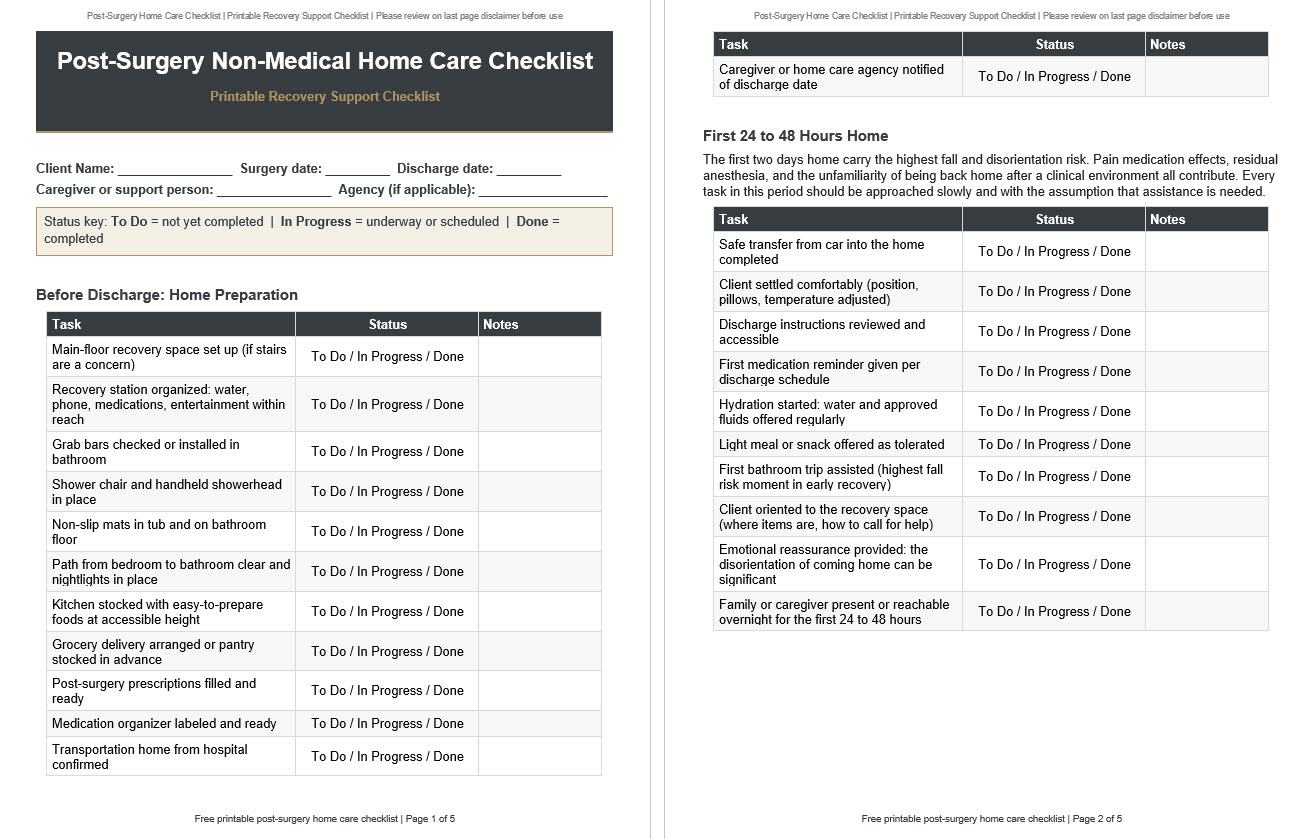
The free printable PDF or editable Doc are available for download by clicking the buttons below.
Surgery ends at the hospital. Recovery happens at home.
That gap between the two is where families are most often caught unprepared. The discharge process moves quickly. Instructions are handed over. Transportation is arranged. And then, suddenly, the person who just underwent a major procedure is home, in pain, exhausted from anesthesia, and trying to get to the bathroom without falling while their family tries to figure out what comes next.
The biggest risks in post-surgery recovery, including falls, malnutrition, medication errors, social isolation, and readmission, are largely preventable with the right support in place before discharge day arrives.
This checklist focuses entirely on the non-medical side of post-surgical recovery: the daily living support, household management, mobility assistance, and companionship that makes healing safer and faster. It is designed for families who are managing recovery at home, with or without professional caregiver support.
Note that wound care, injections, IV medications, and clinical monitoring require a licensed home health or skilled nursing provider. Non-medical home caregivers do not perform these tasks. Where both medical and non-medical support are needed, both types of providers can operate in the same home, and a good home care agency will coordinate with the home health team.
The free printable PDF and editable Doc are available for download by clicking the buttons above.
In-home post-surgery care support across Los Angeles and Orange County by CARE Homecare
A checklist helps you prepare for recovery. A trained caregiver helps make that recovery safer, calmer and more manageable at home. CARE Homecare provides flexible non-medical post-surgery support throughout Los Angeles and Orange County, including personal care, mobility assistance, meal preparation, medication reminders, light housekeeping, transportation and companionship, all organized around the client’s discharge instructions and recovery routine.

Why Non-Medical Support Is Critical After Surgery
A Yale School of Medicine study published in JAMA Network Open found that nearly 1 in 8 older adults (11.6 percent) are readmitted to the hospital within 30 days of major surgery, and more than 1 in 4 (27.6 percent) are readmitted within 180 days. For those with frailty or dementia, the rates are even higher.
What drives those readmissions? Research published in the Journal of the American College of Surgeons found that the leading causes of 30-day readmission after general surgery were gastrointestinal complications (27.6 percent), surgical infection (22.1 percent), and failure to thrive and malnutrition (10.4 percent). Most of these are not inevitable outcomes of surgery. They are outcomes of insufficient support during recovery.
The hospital sends the patient home with discharge instructions. What it does not send is a person to carry those instructions out. Pain, fatigue, and the lingering effects of anesthesia make the simplest tasks, getting to the bathroom safely, preparing a meal, picking up a prescription, taking medications at the right time, genuinely difficult in the days and weeks following discharge.
Without consistent, structured support during this window, recovery becomes harder, slower, and more dangerous. With it, the same recovery period becomes manageable, and the risks of readmission, falls, and complications decrease significantly.
Non-medical home caregivers address the daily living gaps: mobility assistance, meal preparation, medication reminders, light housekeeping, companionship, and transportation. These are not ancillary services. They are the foundation of a safe recovery at home.
Before Surgery | Preparing the Home
The families with the smoothest post-surgery recoveries are the ones who prepared before the procedure, not after. Here is what to have in place before discharge day:
Set up a main-floor recovery station. If the bedroom is on an upper floor and stairs will be difficult to navigate post-surgery, arrange for the person to sleep on the main floor temporarily. Set up the recovery space with water, medications, the phone, remote controls, books or other entertainment, and any items that will be needed regularly, all within reach without bending, reaching, or getting up unnecessarily.
Check bathroom safety. Install or verify grab bars in the shower or tub and near the toilet. Place a shower chair and a handheld showerhead. Lay non-slip mats inside the tub and on the bathroom floor. Check that the path from the bedroom to the bathroom is clear and well-lit.
Prepare the kitchen. Stock easy-to-prepare foods at waist height so nothing requires reaching overhead or bending low. Fill the refrigerator with simple meals and snacks. If dietary restrictions apply based on the expected post-surgery instructions, stock appropriately.
Arrange grocery delivery. Do not count on post-surgery grocery runs being manageable. Set up a delivery service or stock up significantly in advance.
Fill prescriptions in advance. If pre-approved post-surgery prescriptions can be filled before the procedure, do so. Pick up any over-the-counter items, including stool softeners which are commonly needed given the constipating effects of opioid pain medications, and antinausea medications if prescribed, in advance.
Set up the medication organizer. Have a labeled weekly pill organizer ready before discharge, so the medication schedule can be set up immediately upon arrival home.
Confirm transportation and caregiver arrangements. Arrange transportation home from the hospital in advance. If professional home care is planned, contact the agency well before the surgery date to confirm caregiver availability and align the care start date with the discharge date.
Inform the care team of the discharge date. Whether family members or professional caregivers will be managing recovery, everyone should know the expected discharge date, the likely arrival time, and who is responsible for what in the first 24 hours.

Post-Surgery Non-Medical Home Care Checklist
Client Name: Surgery date: Discharge date:
Caregiver or support person: Agency (if applicable):
Status key: To Do = not yet completed | In Progress = underway or scheduled | Done = completed
Before Discharge: Home Preparation
| Task | Status | Notes |
|---|---|---|
| Main-floor recovery space set up (if stairs are a concern) | To Do / In Progress / Done | |
| Recovery station organized: water, phone, medications, entertainment within reach | To Do / In Progress / Done | |
| Grab bars checked or installed in bathroom | To Do / In Progress / Done | |
| Shower chair and handheld showerhead in place | To Do / In Progress / Done | |
| Non-slip mats in tub and on bathroom floor | To Do / In Progress / Done | |
| Path from bedroom to bathroom clear and nightlights in place | To Do / In Progress / Done | |
| Kitchen stocked with easy-to-prepare foods at accessible height | To Do / In Progress / Done | |
| Grocery delivery arranged or pantry stocked in advance | To Do / In Progress / Done | |
| Post-surgery prescriptions filled and ready | To Do / In Progress / Done | |
| Medication organizer labeled and ready | To Do / In Progress / Done | |
| Transportation home from hospital confirmed | To Do / In Progress / Done | |
| Caregiver or home care agency notified of discharge date | To Do / In Progress / Done |
First 24 to 48 Hours Home
The first two days home carry the highest fall and disorientation risk. Pain medication effects, residual anesthesia, and the unfamiliarity of being back home after a clinical environment all contribute. Every task in this period should be approached slowly and with the assumption that assistance is needed.
| Task | Status | Notes |
|---|---|---|
| Safe transfer from car into the home completed | To Do / In Progress / Done | |
| Client settled comfortably (position, pillows, temperature adjusted) | To Do / In Progress / Done | |
| Discharge instructions reviewed and accessible | To Do / In Progress / Done | |
| First medication reminder given per discharge schedule | To Do / In Progress / Done | |
| Hydration started: water and approved fluids offered regularly | To Do / In Progress / Done | |
| Light meal or snack offered as tolerated | To Do / In Progress / Done | |
| First bathroom trip assisted (highest fall risk moment in early recovery) | To Do / In Progress / Done | |
| Client oriented to the recovery space (where items are, how to call for help) | To Do / In Progress / Done | |
| Emotional reassurance provided: the disorientation of coming home can be significant | To Do / In Progress / Done | |
| Family or caregiver present or reachable overnight for the first 24 to 48 hours | To Do / In Progress / Done |
Daily Tasks During Recovery
| Task | Status | Notes |
|---|---|---|
| Morning personal care: bathing with shower chair assist, dressing, grooming | To Do / In Progress / Done | |
| Medication reminders given at all scheduled times (reminders only, not administration) | To Do / In Progress / Done | |
| Breakfast and all meals prepared to support recovery nutrition | To Do / In Progress / Done | |
| Hydration reminders throughout the day | To Do / In Progress / Done | |
| Pathways checked and cleared of fall hazards | To Do / In Progress / Done | |
| Kitchen cleaned after meals | To Do / In Progress / Done | |
| Companionship: conversation, activities within ability, reducing isolation | To Do / In Progress / Done | |
| Mobility assistance: walking to bathroom, kitchen, or as cleared by physician | To Do / In Progress / Done | |
| Short walks completed as approved by surgeon or physician | To Do / In Progress / Done | |
| Transportation to follow-up appointments, physical therapy, or pharmacy | To Do / In Progress / Done | |
| Observation notes recorded: appetite, mood, mobility, any concerns | To Do / In Progress / Done | |
| Any changes from baseline flagged to family or care team | To Do / In Progress / Done |
Weekly Tasks During Recovery
| Task | Status | Notes |
|---|---|---|
| Laundry completed, including bed linens | To Do / In Progress / Done | |
| Grocery shopping or delivery coordinated | To Do / In Progress / Done | |
| Bathroom and kitchen cleaned | To Do / In Progress / Done | |
| Medication supply checked and refills arranged as needed | To Do / In Progress / Done | |
| Medication organizer refilled for the coming week | To Do / In Progress / Done | |
| Recovery progress communicated to family | To Do / In Progress / Done | |
| Follow-up appointment schedule reviewed and transportation confirmed | To Do / In Progress / Done |
Recovery notes and observations:
Items to flag for the care team or physician:
Caregiver or support person: Date:

Common Post-Surgery Risks and How Non-Medical Caregivers Help Prevent Them
Understanding the specific risks of post-surgery recovery at home, and what non-medical caregivers do to address each one, helps families build a more targeted and effective support plan.
Falls. Fall risk is dramatically elevated in the first weeks after surgery due to pain, medication side effects, reduced mobility, and unfamiliarity with the recovery environment. Non-medical caregivers assist with every transfer and ambulation, clear pathways before each movement, ensure bathroom safety, and maintain appropriate lighting at all times. A fall in the first days home can undo the surgical outcome entirely.
Malnutrition and poor appetite. Surgical patients frequently experience appetite suppression in the first week or two following a procedure, due to medication effects, pain, and the general disruption of normal routine. A non-medical caregiver prepares regular, appealing meals tailored to the person’s preferences and any dietary restrictions in the discharge instructions, ensures hydration throughout the day, and documents intake to flag concerns to the family or care team.
Constipation. Constipation is among the most common complications in the first days after surgery. Opioid pain medications directly inhibit gastrointestinal motility, and reduced movement compounds the effect. Research confirms that opioids directly suppress gastrointestinal and colonic motility, making post-surgical constipation a predictable and well-documented outcome of standard pain management protocols. (PMC5565678) Constipation increases pain, reduces appetite, and can delay recovery significantly. Non-medical caregivers support prevention by ensuring high-fiber foods and fluids are included in meals, encouraging gentle movement as approved, and flagging persistent constipation to the healthcare team for clinical management.
Isolation and low mood. Returning home after surgery often brings a period of unexpected emotional difficulty. The combination of pain, limited mobility, disrupted sleep, and the loss of the social stimulation and structured environment of the hospital can produce significant low mood. This is not a mental health crisis in most cases, but it is a genuine risk to recovery. Regular companionship, conversation, simple activities within the person’s current ability, and consistent supportive presence from a caregiver all reduce isolation and support the emotional conditions that promote physical healing.
Missed follow-up appointments. Post-surgery follow-up appointments are not optional. They are where surgical complications are caught early, wound healing is assessed, medications are adjusted, and recovery progress is evaluated. A non-medical caregiver who provides transportation and appointment reminders ensures that these critical touchpoints happen reliably.

What Non-Medical Home Care Covers vs. What It Does Not
Clarity about scope is important for trust and for safety. Here is a plain-language summary of what non-medical home care covers and does not cover in a post-surgical context.
Within scope for non-medical home caregivers: Personal care (bathing, dressing, grooming, toileting, transfers). Meal preparation and kitchen management. Medication reminders (prompting the person to take their medication at the scheduled time and logging it, not administering or making clinical decisions about dosing). Light housekeeping and fall-hazard management. Companionship. Transportation to appointments, therapy, and errands. Observation and documentation of changes in condition, with escalation to the family or care team.
Outside scope for non-medical home caregivers: Wound care, dressing changes, or incision management. IV medications or infusions. Injections of any kind. Clinical assessment or vital sign monitoring. Physical therapy or occupational therapy. Making clinical decisions about medications. Any task that requires a licensed clinical credential.
If post-surgical needs include both medical and non-medical support, both types of providers can operate in parallel. CARE Homecare coordinates regularly with home health agencies and discharge planners to ensure that the non-medical and medical components of a post-surgical care plan work together without overlap or gaps.
For a more detailed breakdown of what non-medical caregivers do within their scope, see our guide to what home care providers do.

How to Plan for Post-Surgery Home Care Before You Leave the Hospital
The families who manage post-surgical recovery most effectively are the ones who made care arrangements before the procedure, not after discharge.
Request a discharge planning meeting before the surgery date. Every hospital has a discharge planning team or social worker whose job is to help patients transition safely home. Ask for a meeting before the procedure to discuss what post-surgical support needs are likely to look like, what the hospital recommends, and what the discharge process will entail.
Inform the home care agency of the anticipated discharge date as soon as you know it. Home care agencies schedule caregivers around confirmed dates. Calling the agency the day before discharge is too late in most cases to guarantee the caregiver you want, at the time you need them. Earlier notice means better coverage.
Confirm that the caregiver start date aligns with the discharge date. The highest-risk period of post-surgical recovery is the first 24 to 72 hours home. This is not the window to have a gap in coverage. The caregiver should be present or on call from the moment the person arrives home.
Review the discharge instructions with the caregiver before care begins. Discharge instructions contain critical information about activity restrictions, dietary guidelines, medication schedules, wound care (handled by the home health team), and warning signs that require a call to the physician. The non-medical caregiver needs to understand the full picture of what recovery should look like and what falls outside normal.
Build in follow-up appointments from day one. Post-surgical follow-up appointments should be scheduled before discharge and transportation confirmed immediately. Do not leave this to the patient to manage in the first days home.
For more on navigating the transition from hospital to home, see our family guide to home care after hospital discharge and our hospital discharge checklist.
In-home post-surgery care support across Los Angeles and Orange County by CARE Homecare
Recovery happens at home, one day at a time. But it does not have to happen without support. CARE Homecare provides non-medical post-surgical home care throughout Los Angeles and Orange County, including personal care, meal preparation, mobility assistance, medication reminders, and companionship, all coordinated around each person’s discharge instructions and recovery timeline.
If you are planning for an upcoming surgery or managing an unexpected discharge, contact us to arrange a care consultation before the procedure date. See our post-hospital home care services or call for a free 15-minute consultation.
Call (323) 851-1422 Email: info@carehomecare.com

Sources
- Wang Y, Gill TM, Becher RD, et al. “National Estimates of Short- and Longer-Term Hospital Readmissions After Major Surgery Among Community-Living Older Adults.” JAMA Network Open. 2024;7(2):e240010. https://jamanetwork.com/journals/jamanetworkopen/fullarticle/2815588
- Yale School of Medicine News. “Risk of hospital readmission after surgery is high for older Americans.” February 28, 2024. https://news.yale.edu/2024/02/28/risk-hospital-readmission-after-surgery-high-older-americans
- Kassin MT, Owen RM, Perez SD, Leeds I, Cox JC, Schnier K, Sadiraj V, Sweeney JF. “Risk Factors for 30-Day Hospital Readmission Among General Surgery Patients.” Journal of the American College of Surgeons. 2012;215(3):322–330. doi:10.1016/j.jamcollsurg.2012.05.024. https://pmc.ncbi.nlm.nih.gov/articles/PMC3423490/
- Camilleri M, Bharucha AE, Farrugia G. “Epidemiology, Mechanisms, and Management of Diabetic Gastroparesis.” Clinical Gastroenterology and Hepatology. 2011. Reviewed in: “Opioids in Gastroenterology: Treating Adverse Effects and Creating Therapeutic Benefits.” PMC. 2017. https://pmc.ncbi.nlm.nih.gov/articles/PMC5565678/
- California Department of Social Services. Home Care Services Branch. “Home Care Services Consumer Protection Act.” Accessed May 2026. https://www.cdss.ca.gov/inforesources/community-care/home-care-services
Related Resources
- Hospital Discharge Checklist | A complete checklist for the transition from hospital to home
- A Family Guide to Home Care After Hospital Discharge | What families need to know about the post-discharge period
- The First 72 Hours at Home After Hospital Discharge | A detailed guide to the highest-risk period of recovery
- Home Safety Checklist for Seniors | Identify and address fall hazards before recovery begins
- Home Care Supplies Checklist | What to have ready at home before care starts
- What Do Home Care Providers Do? | A plain-language breakdown of non-medical caregiver scope
Disclaimer: The information on this page is intended for general educational purposes only and does not constitute medical, legal, or professional care advice. The post-surgery home care checklist provided here covers non-medical support tasks only and is not a substitute for professional medical guidance, discharge instructions from a licensed healthcare provider, or clinical assessment by a qualified professional. Wound care, IV medications, injections, and skilled nursing require a licensed home health provider. CARE Homecare provides non-medical home care services only. If you have concerns about a loved one’s health, safety, or recovery, please consult a qualified medical professional.
 https://carehomecare.com/wp-content/uploads/2026/05/Post-Surgery-Home-Care-Checklist-Non-Medical-Support-for-Recovery-at-Home-Free-PDF-and-Word-Download.jpg
839
1315
Moti Gamburd
https://a81019caredemo.wpengine.com/wp-content/uploads/2019/08/CARE-Homecare-Logo-wht.png
Moti Gamburd2026-05-14 20:03:392026-05-14 20:03:39Free Post-Surgery Home Care Checklist | Non-Medical Support for Recovery at Home | PDF or Word Print or Download
https://carehomecare.com/wp-content/uploads/2026/05/Post-Surgery-Home-Care-Checklist-Non-Medical-Support-for-Recovery-at-Home-Free-PDF-and-Word-Download.jpg
839
1315
Moti Gamburd
https://a81019caredemo.wpengine.com/wp-content/uploads/2019/08/CARE-Homecare-Logo-wht.png
Moti Gamburd2026-05-14 20:03:392026-05-14 20:03:39Free Post-Surgery Home Care Checklist | Non-Medical Support for Recovery at Home | PDF or Word Print or Download https://carehomecare.com/wp-content/uploads/2026/05/Home-Care-Supplies-Preparation-Checklist.jpg
842
1316
Moti Gamburd
https://a81019caredemo.wpengine.com/wp-content/uploads/2019/08/CARE-Homecare-Logo-wht.png
Moti Gamburd2026-05-14 18:49:452026-05-14 18:49:45Home Care Supplies Checklist | What to Have Ready Before Care Starts | Free Printable PDF
https://carehomecare.com/wp-content/uploads/2026/05/Home-Care-Supplies-Preparation-Checklist.jpg
842
1316
Moti Gamburd
https://a81019caredemo.wpengine.com/wp-content/uploads/2019/08/CARE-Homecare-Logo-wht.png
Moti Gamburd2026-05-14 18:49:452026-05-14 18:49:45Home Care Supplies Checklist | What to Have Ready Before Care Starts | Free Printable PDF https://carehomecare.com/wp-content/uploads/2026/05/Light-Housekeeping-Checklist-for-Home-Caregivers-1.jpg
832
1080
Moti Gamburd
https://a81019caredemo.wpengine.com/wp-content/uploads/2019/08/CARE-Homecare-Logo-wht.png
Moti Gamburd2026-05-13 11:11:172026-05-14 02:13:21Light Housekeeping Checklist for Home Caregivers | Free Printable PDF
https://carehomecare.com/wp-content/uploads/2026/05/Light-Housekeeping-Checklist-for-Home-Caregivers-1.jpg
832
1080
Moti Gamburd
https://a81019caredemo.wpengine.com/wp-content/uploads/2019/08/CARE-Homecare-Logo-wht.png
Moti Gamburd2026-05-13 11:11:172026-05-14 02:13:21Light Housekeeping Checklist for Home Caregivers | Free Printable PDF https://carehomecare.com/wp-content/uploads/2026/05/Home-Safety-Checklist-for-Seniors-Free-Printable-Room-by-Room-Guide-PDF-Download.jpg
804
1042
Moti Gamburd
https://a81019caredemo.wpengine.com/wp-content/uploads/2019/08/CARE-Homecare-Logo-wht.png
Moti Gamburd2026-05-12 01:27:302026-05-13 02:09:16Home Safety Checklist for Seniors | Room by Room (Free Printable PDF)
https://carehomecare.com/wp-content/uploads/2026/05/Home-Safety-Checklist-for-Seniors-Free-Printable-Room-by-Room-Guide-PDF-Download.jpg
804
1042
Moti Gamburd
https://a81019caredemo.wpengine.com/wp-content/uploads/2019/08/CARE-Homecare-Logo-wht.png
Moti Gamburd2026-05-12 01:27:302026-05-13 02:09:16Home Safety Checklist for Seniors | Room by Room (Free Printable PDF) https://carehomecare.com/wp-content/uploads/2026/05/In-Home-Care-Agency-Checklist-Questions-to-Ask-Before-You-Hire.jpg
831
1078
Moti Gamburd
https://a81019caredemo.wpengine.com/wp-content/uploads/2019/08/CARE-Homecare-Logo-wht.png
Moti Gamburd2026-05-04 01:29:142026-05-13 02:07:13In-Home Care Agency Checklist | Questions to Ask Before You Hire
https://carehomecare.com/wp-content/uploads/2026/05/In-Home-Care-Agency-Checklist-Questions-to-Ask-Before-You-Hire.jpg
831
1078
Moti Gamburd
https://a81019caredemo.wpengine.com/wp-content/uploads/2019/08/CARE-Homecare-Logo-wht.png
Moti Gamburd2026-05-04 01:29:142026-05-13 02:07:13In-Home Care Agency Checklist | Questions to Ask Before You Hire https://carehomecare.com/wp-content/uploads/2026/05/Dementia-Daily-Caregiver-Checklist-Free-Printable-PDF-for-Home-Care.jpg
831
1078
Moti Gamburd
https://a81019caredemo.wpengine.com/wp-content/uploads/2019/08/CARE-Homecare-Logo-wht.png
Moti Gamburd2026-05-03 00:17:592026-05-13 02:09:49Dementia Daily Caregiver Checklist | Free Printable PDF for Home Care
https://carehomecare.com/wp-content/uploads/2026/05/Dementia-Daily-Caregiver-Checklist-Free-Printable-PDF-for-Home-Care.jpg
831
1078
Moti Gamburd
https://a81019caredemo.wpengine.com/wp-content/uploads/2019/08/CARE-Homecare-Logo-wht.png
Moti Gamburd2026-05-03 00:17:592026-05-13 02:09:49Dementia Daily Caregiver Checklist | Free Printable PDF for Home Care https://carehomecare.com/wp-content/uploads/2026/05/ADL-IADL-Checklist-for-Seniors-Free-Printable-Assessment-PDF-Download.jpg
795
1041
Moti Gamburd
https://a81019caredemo.wpengine.com/wp-content/uploads/2019/08/CARE-Homecare-Logo-wht.png
Moti Gamburd2026-05-01 17:41:202026-05-13 02:10:25ADL / IADL Checklist for Seniors - Free Printable Assessment (PDF Download)
https://carehomecare.com/wp-content/uploads/2026/05/ADL-IADL-Checklist-for-Seniors-Free-Printable-Assessment-PDF-Download.jpg
795
1041
Moti Gamburd
https://a81019caredemo.wpengine.com/wp-content/uploads/2019/08/CARE-Homecare-Logo-wht.png
Moti Gamburd2026-05-01 17:41:202026-05-13 02:10:25ADL / IADL Checklist for Seniors - Free Printable Assessment (PDF Download) https://carehomecare.com/wp-content/uploads/2026/05/Free-Printable-Caregiver-Daily-Checklist-for-Elderly-PDF-Download.jpg
877
1352
Moti Gamburd
https://a81019caredemo.wpengine.com/wp-content/uploads/2019/08/CARE-Homecare-Logo-wht.png
Moti Gamburd2026-04-21 16:12:122026-05-14 02:01:30Free Printable Caregiver Daily Checklist for Elderly (PDF Download)
https://carehomecare.com/wp-content/uploads/2026/05/Free-Printable-Caregiver-Daily-Checklist-for-Elderly-PDF-Download.jpg
877
1352
Moti Gamburd
https://a81019caredemo.wpengine.com/wp-content/uploads/2019/08/CARE-Homecare-Logo-wht.png
Moti Gamburd2026-04-21 16:12:122026-05-14 02:01:30Free Printable Caregiver Daily Checklist for Elderly (PDF Download) https://carehomecare.com/wp-content/uploads/2026/03/24-7-vs-12-Hour-Shifts-for-Home-Care.jpg
1706
2553
Mendy Perlman
https://a81019caredemo.wpengine.com/wp-content/uploads/2019/08/CARE-Homecare-Logo-wht.png
Mendy Perlman2026-03-14 03:46:542026-03-15 03:52:2924/7 vs 12-Hour Shifts for Home Care - Coverage Models to Compare
https://carehomecare.com/wp-content/uploads/2026/03/24-7-vs-12-Hour-Shifts-for-Home-Care.jpg
1706
2553
Mendy Perlman
https://a81019caredemo.wpengine.com/wp-content/uploads/2019/08/CARE-Homecare-Logo-wht.png
Mendy Perlman2026-03-14 03:46:542026-03-15 03:52:2924/7 vs 12-Hour Shifts for Home Care - Coverage Models to Compare