
Contents
Dementia Daily Caregiver Checklist | Free Printable PDF for Non-Medical Home Care
Use this free printable dementia daily caregiver checklist to bring structure and consistency to every shift – covering morning routines, behavioral observations, sundowning, and more. PDF download included.
Download or Print the Dementia Daily Caregiver Checklist
Dementia care is unpredictable by nature. This checklist gives every shift a reliable starting point – organized around the natural cognitive rhythm of the day, with space to document what happened, what changed, and what the next caregiver needs to know.
It is designed for family caregivers managing care at home, professional aides working with dementia clients, and anyone coordinating care across multiple people or shifts.
Tip: Complete the observation log at the end of every shift, not just when something goes wrong. Patterns in mood, appetite, sleep, and behavior are often invisible day to day but become clear when you have a written record to look back on.
Caring for someone with dementia is not just hard. It is unpredictable in a way that most caregiving is not. The same person who was calm and cooperative yesterday may be anxious, resistive, or deeply confused today. A morning that went smoothly last week may unravel this week for no obvious reason. Without a plan, each day becomes a series of improvisations, and that constant redirection wears caregivers down faster than almost anything else.
Structure is not a luxury in dementia care. It is a clinical strategy. A consistent daily routine reduces anxiety, decreases behavioral disturbances, and gives the person with dementia a framework to move through the day with less confusion and more dignity. This page is for family caregivers and professional aides managing dementia care at home who need a system that is both structured and flexible enough to meet the person where they are today.
The checklist below is designed specifically for non-medical in-home dementia care tasks. It does not cover medical procedures, skilled nursing, or clinical assessment. For those needs, a licensed home health provider is required.
The free printable PDF is available for download by clicking the PDF button above or you can preview it by scrolling to the checklist section below.
In-home dementia care support across Los Angeles and Orange County by CARE Homecare
A checklist brings structure to the day. A trained dementia caregiver brings the consistency, patience, and experience to make that structure actually work. CARE Homecare provides flexible non-medical dementia and Alzheimer’s care throughout Los Angeles and Orange County, with caregivers experienced in the communication techniques and behavioral strategies that make home care safe and sustainable.
If you are not sure what professional dementia caregiving actually looks like day to day, see what home care providers do for a plain-language breakdown, or visit our Alzheimer’s and dementia care services page to learn how we build care plans around each person’s current stage and needs.
Why Routine Is Medicine for Dementia
The brain changes caused by Alzheimer’s disease and related dementias make unpredictability genuinely distressing. When a person cannot reliably form new memories or process what is happening around them, the familiar becomes a lifeline. A consistent routine creates a kind of scaffolding that the damaged brain can lean on, even when it can no longer construct that scaffolding on its own.
According to the Alzheimer’s Association, structured and pleasant activities can often reduce agitation and improve mood, and a planned day allows caregivers to spend less time figuring out what to do and more time on activities that provide meaning and enjoyment. This is not a minor benefit. Behavioral symptoms, including agitation, wandering, and resistance to care, are among the most physically and emotionally exhausting aspects of dementia caregiving. A consistent routine reduces their frequency.
The Alzheimer’s Association recommends non-pharmacological strategies, including environmental modifications, structured routines, and psychosocial interventions, as a first-line approach to managing behavioral and psychological symptoms of dementia. In practice, this means that a well-designed daily checklist is not just a scheduling tool. It is a behavioral support strategy.
The benefits work both ways. Caregivers who follow a consistent routine report feeling less burdened, more confident, and better able to anticipate and manage behavioral challenges before they escalate. The checklist does not eliminate the hard days. But it reduces their frequency and gives caregivers a reliable starting point when things do go sideways.
What Makes a Dementia Care Checklist Different
A standard daily caregiver checklist tracks task completion. A dementia-specific checklist has to do more than that. Here is what makes dementia care checklists fundamentally different from general elderly care checklists.
Cognitive variability throughout the day. Most people living with dementia have better cognitive function in the morning, when they are rested and the accumulated fatigue and overstimulation of the day have not yet set in. A dementia checklist is organized around this reality, front-loading cognitively demanding tasks like hygiene, orientation, and engagement activities into the morning window and reserving simpler, more passive activities for the afternoon and evening.
Communication requires a different approach. How a task is introduced matters as much as what the task is. Telling someone with dementia “it is time to shower” and expecting compliance is very different from gently leading them through each step one at a time with a calm voice and no rushing. A dementia checklist includes reminders about communication approach alongside the task itself, not just a box to tick.
Behavioral triggers must be anticipated. Certain times of day, certain tasks (bathing is a common one), and certain environmental factors reliably increase distress for many people with dementia. The checklist builds in awareness of these triggers and flags them as moments that require extra patience and preparation.
The goal is not past capability but present ability. A person with mid-stage dementia who used to manage their own hygiene independently may now need full assistance. The checklist meets them where they are today, not where they were six months ago. This requires updating the checklist regularly as the disease progresses.
Documentation is part of the care. Behavioral observations, appetite changes, sleep quality, and mood shifts are not incidental. They are data that helps the care team, including family members, physicians, and professional caregivers, identify patterns, anticipate problems, and adjust the care plan. The observation log at the end of this checklist is as important as the task sections.
Stage-by-Stage Considerations
Dementia is a progressive condition, and the daily care needs of someone in the early stages look very different from someone in the middle or late stages. Understanding where your loved one currently is helps you build a checklist that is appropriately scaled.
Early-stage dementia. The person can still manage many tasks independently but may need reminders and gentle prompting. Orientation cues (day, date, what is planned for the day) are helpful. Medication reminders are important. Cognitive engagement activities, including conversation, reading, puzzles, and familiar hobbies, are still meaningful and valuable. The primary caregiver role at this stage is supportive rather than hands-on, and the person’s own preferences and routines should be incorporated wherever possible.
Middle-stage dementia. During the middle stages, damage to the brain can make it difficult to express thoughts and perform routine tasks. You may notice the person jumbling words, having trouble dressing, getting frustrated or angry, or acting in unexpected ways, such as refusing to bathe. At this stage, the caregiver takes a much more active role in personal care, meal preparation, and activity facilitation. The checklist becomes more detailed, and the observation log becomes more critical for tracking behavioral patterns.
Late-stage dementia. The person requires assistance with virtually all activities of daily living. Communication is limited. Comfort, dignity, sensory engagement (familiar music, gentle touch, familiar scents), and consistent presence become the primary goals. The checklist at this stage focuses less on activities and more on comfort care: positioning, skin checks, oral hygiene, hydration, and quiet companionship.
CARE Homecare provides non-medical in-home dementia care support at all stages, with care plans tailored to the person’s current abilities and adjusted as needs change.

Dementia Daily Caregiver Checklist – Free Printable PDF
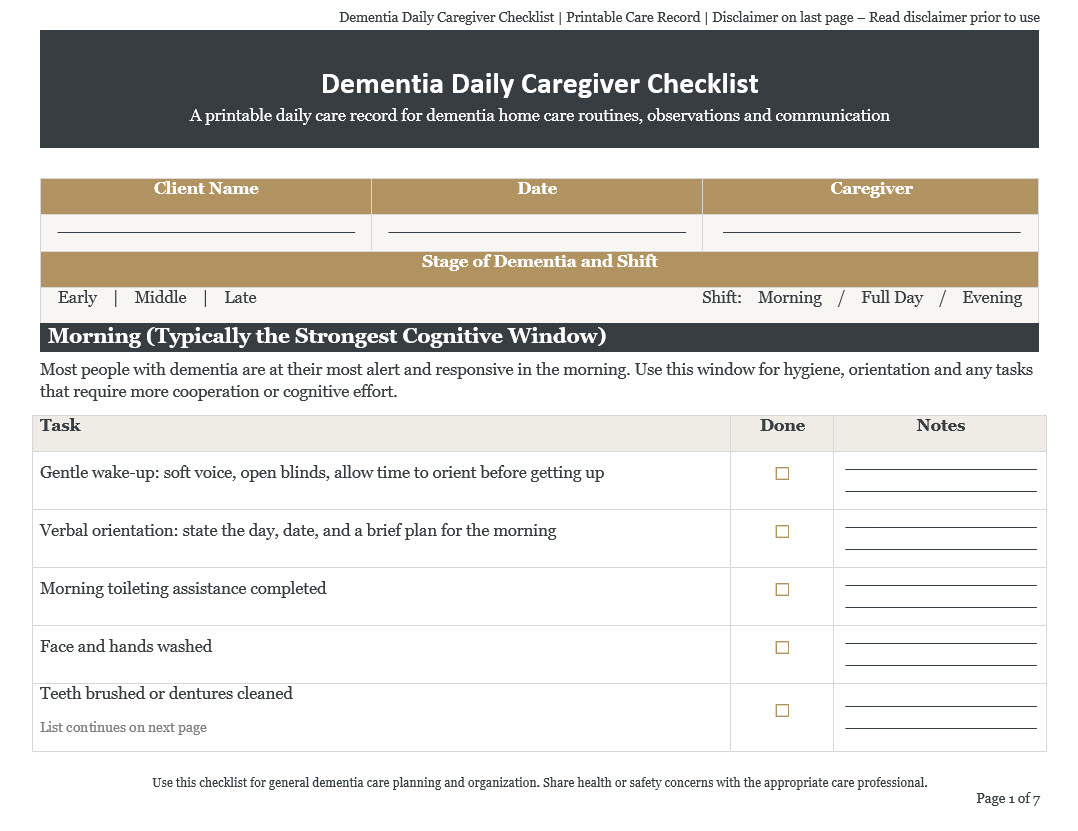
The checklist below is organized by time of day to align with the natural cognitive rhythm of most people living with dementia. Each section includes a notes field for relevant observations. A daily observation log follows at the end.
Dementia Daily Care Checklist
Client Name: ____________________ Date: ____________________ Caregiver: ____________________
Stage of dementia (circle): Early | Middle | Late Shift: Morning / Full Day / Evening
Morning (Typically the Strongest Cognitive Window)
Most people with dementia are at their most alert and responsive in the morning. Use this window for hygiene, orientation, and any tasks that require more cooperation or cognitive effort.
| Task | Done | Notes |
|---|---|---|
| Gentle wake-up: soft voice, open blinds, allow time to orient before getting up | ☐ | |
| Verbal orientation: state the day, date, and a brief plan for the morning | ☐ | |
| Morning toileting assistance completed | ☐ | |
| Face and hands washed | ☐ | |
| Teeth brushed or dentures cleaned | ☐ | |
| Hair combed and groomed | ☐ | |
| Shaved (if applicable and preferred) | ☐ | |
| Dressed in comfortable, appropriate clothing (offer limited choices where possible) | ☐ | |
| Breakfast served: familiar, simple foods | ☐ | |
| Fluids offered and intake noted | ☐ | |
| Morning medication reminder given and confirmed | ☐ | |
| Morning orientation or cognitive engagement activity completed | ☐ | |
| Mood and alertness on waking noted below | ☐ |
Morning section notes:
____________________________________________________________
Midday
The middle of the day is generally a time for lighter activity, social connection, rest, and lunch. Avoid scheduling demanding tasks or appointments in the afternoon if sundowning is a concern.
| Task | Done | Notes |
|---|---|---|
| Light physical activity or short walk completed (weather and mobility permitting) | ☐ | |
| Lunch served: monitor intake and watch for any difficulty chewing or swallowing | ☐ | |
| Midday fluids offered and intake noted | ☐ | |
| Afternoon medication reminder given and confirmed (if applicable) | ☐ | |
| Rest period observed (note duration) | ☐ | |
| Afternoon activity completed (art, puzzles, photos, music, folding towels, garden walk) | ☐ | |
| Social time: in-person visit, phone call, or video chat with family | ☐ | |
| Skin check completed during rest or clothing change (note any concerns) | ☐ |
Midday section notes:
____________________________________________________________
Evening
The evening routine should be calm, familiar, and low-stimulation. Sundowning, which typically begins in the late afternoon and early evening, is more likely when the person is overtired, overstimulated, or off-schedule. Keep the environment quiet, well-lit, and predictable.
| Task | Done | Notes |
|---|---|---|
| Dinner served: familiar, simple, comfortable foods | ☐ | |
| Evening fluids offered and intake noted | ☐ | |
| Evening medication reminder given and confirmed | ☐ | |
| Wind-down activity: calm music, gentle conversation, familiar TV program (avoid news or stimulating content) | ☐ | |
| Evening hygiene: bath or shower (whichever is less distressing for this person), or bed bath if preferred | ☐ | |
| Oral hygiene completed | ☐ | |
| Changed into comfortable nightwear | ☐ | |
| Bedroom prepared: nightlight on, path to bathroom clear, door alarm checked if applicable | ☐ | |
| Bedtime routine completed at consistent time | ☐ | |
| Final check-in: comfort, hydration, and call system within reach | ☐ |
Evening section notes:
____________________________________________________________
Daily Observation Log
This section is as important as the task checklist. Behavioral and physical observations help identify patterns, flag concerns for the healthcare team, and build a running record that informs the care plan over time.
Overall mood today:
☐ Calm and engaged ☐ Anxious or restless ☐ Confused or disoriented ☐ Withdrawn ☐ Agitated ☐ Other: ____________
Appetite today:
☐ Good (ate most of meals) ☐ Fair (ate about half) ☐ Poor (ate very little) ☐ Refused to eat
Fluid intake today: ____________ glasses or cups
Sleep last night:
☐ Slept well ☐ Restless ☐ Up multiple times ☐ Did not sleep
Wandering behavior observed: ☐ Yes ☐ No Details: ____________
Sundowning behavior observed: ☐ Yes ☐ No Time of onset: ____________ Description: ____________
Repetitive questions or behaviors noted: ☐ Yes ☐ No Description: ____________
Resistive to care (specify task): ☐ Yes ☐ No Details: ____________
Any falls or near-falls: ☐ Yes ☐ No Details: ____________
Skin concerns (redness, bruising, breakdown): ☐ Yes ☐ No Details: ____________
Pain or discomfort indicated: ☐ Yes ☐ No Description: ____________
Changes from recent baseline:
____________________________________________________________
Items to flag for family or care team:
____________________________________________________________
Caregiver signature: ____________________ Time completed: ____________________
Communication Tips for Dementia Caregivers
Knowing what to do is only half of dementia care. How you communicate while doing it determines whether a task goes smoothly or becomes a struggle. These communication principles make the checklist easier to actually execute.
Speak calmly and simply. Use short sentences and familiar words. Avoid complex instructions or multi-step requests. Your tone of voice carries as much information as your words for someone whose language processing is impaired.
One step at a time. Instead of saying “go wash your hands and get dressed for breakfast,” say “let’s wash your hands first.” Complete one step, then introduce the next. Overwhelming the person with what comes next creates anxiety before the current task is even finished.
Use their name. Beginning a request with the person’s name gently orients them to the interaction and signals that you are speaking to them, not at them.
Avoid arguing or correcting. If the person believes it is 1975, or that they need to pick their children up from school, correcting that belief directly will not update their understanding. It will create distress. Redirect toward the present moment rather than confronting the error. The goal is to reduce anxiety, not to establish factual accuracy.
Redirect instead of confront. When a person with Alzheimer’s becomes agitated, creating a calm environment, removing stressors, and offering a security object, rest, or privacy can help reduce symptoms. Changing the subject, suggesting a brief walk, or offering a familiar object can de-escalate a difficult moment more effectively than any explanation.
Match your body language to your tone. Dementia progressively erodes the ability to process spoken language while often preserving sensitivity to non-verbal cues. A calm expression, open posture, and slow, unhurried movements communicate safety even when words no longer do.
Give extra time. Processing speed slows significantly with dementia. Ask a question or make a request, then wait. Resist the urge to repeat or rephrase immediately. Silence is not resistance. It is often just processing.

Managing Wandering, Sundowning, and Difficult Behaviors
These are the behaviors that exhaust caregivers most and that families worry about before care even begins. None of them is manageable every time, but all of them can be reduced in frequency and severity with the right approach.
Wandering
According to the Alzheimer’s Association, up to 60 percent of people with dementia will wander at some point during the course of their disease, making it one of the most common and serious safety risks in home care. Wandering often reflects an unmet need: boredom, discomfort, a search for something familiar, or a response to confusion about where the person is or what time it is.
Practical strategies include door alarms that alert when an exterior door is opened, GPS tracking devices worn as a watch or in a pocket, visual deterrents like stop signs on exit doors (which can reduce wandering attempts in some individuals), and ensuring the person has adequate physical activity and engagement during the day to reduce restlessness. A secure outdoor space, if available, gives the person a safe place to move without the risk of leaving the property. If wandering is a concern, consider enrolling the person in the MedicAlert Safe & Found program, a 24/7 emergency response service operated by MedicAlert Foundation in partnership with the Alzheimer’s Association, which activates a community support network including law enforcement and local hospitals when a person with dementia is reported missing.
Sundowning
Sundowning refers to the increase in confusion, agitation, and behavioral disturbance that many people with dementia experience in the late afternoon and evening hours. The Alzheimer’s Association estimates that at least 20 percent of people with Alzheimer’s disease experience sundowning, though peer-reviewed research suggests considerably higher rates depending on care setting and how the syndrome is measured, with some studies reporting prevalence as high as 66 percent. It is thought to be linked to disruptions in circadian rhythm, inadequate daytime light exposure, fatigue, and unmet needs such as hunger or pain.
The checklist supports sundowning management by keeping the evening routine consistent, low-stimulation, and predictable. Additional strategies include keeping the home well-lit in the late afternoon and early evening (darkness increases confusion), encouraging physical activity and natural light exposure earlier in the day, offering a larger midday meal and a lighter dinner to reduce the physical discomfort that can worsen late-day agitation, and avoiding overstimulating activities or environments in the hours before bedtime.
The Alzheimer’s Association recommends scheduling demanding activities such as doctor appointments, trips, and bathing in the morning or early afternoon hours when the person is more alert, and reducing stimulation during the evening hours, avoiding TV, chores, or loud music that may add to confusion.
Agitation and Anxiety
Agitation in dementia is almost always a response to something: pain, discomfort, overstimulation, frustration with a task, an unfamiliar environment, or an unmet need the person cannot express. Non-pharmacological strategies including environmental modifications, structured routines, and psychosocial interventions are recommended as a first-line approach.
Practical strategies include identifying and removing the trigger where possible, offering sensory comfort (a warm blanket, a familiar object, soft music), using calm and steady verbal reassurance, reducing background noise and visual clutter, and redirecting to a preferred activity or topic. Keep a record of what preceded agitation episodes in the observation log. Patterns often emerge that make future episodes easier to anticipate and prevent.
Self-Care for the Dementia Caregiver
Dementia caregiving is not like other caregiving. The behavioral unpredictability, the emotional complexity of watching a person you love lose themselves progressively, and the frequent lack of acknowledgment or reciprocity make it one of the most psychologically demanding caregiving situations that exists. Burnout is not a character flaw in dementia caregivers. It is the predictable outcome of an unsustainable level of demand without adequate relief.
If you are providing dementia care at home, whether as a family member or a professional, the following are not optional extras. They are part of the care plan.
Respite care is not abandonment. Taking a break from caregiving does not mean you have stopped caring. It means you are protecting your capacity to keep caring. Respite care, whether from a rotating professional caregiver, a family member, or an adult day program, is what allows family caregivers to sustain their involvement over months and years rather than collapsing under the load in weeks.
Document the hard days. Using the observation log consistently gives you an objective record of behavioral patterns. This serves two purposes: it helps identify what is escalating and what is improving, and it provides concrete data to share with a physician or care manager who may not see the day-to-day reality.
Know the signs of burnout before they become a crisis. Our free caregiver burnout self-check worksheet is a structured way to assess whether the stress you are carrying has crossed into territory that requires intervention. If you are regularly feeling resentful, physically unwell, unable to sleep, or emotionally numb, those are signals, not weaknesses.
Rotating caregivers reduce burnout and benefit the person with dementia too. A person with dementia who has consistent exposure to more than one trained caregiver maintains greater social engagement and is less likely to become exclusively dependent on a single person, which protects the family caregiver as well as the person receiving care.

When Home Dementia Care Needs Professional Support
There are specific signs that dementia care at home has reached a level that requires consistent professional support: the person is wandering and keeping them safe requires around-the-clock supervision that one person cannot reliably provide; sundowning is severe and regular, meaning the evenings are becoming genuinely unsafe or unmanageable; the primary caregiver is showing signs of burnout that are affecting their own health; personal care tasks like bathing, dressing, and toileting have become consistently resistive and require skilled, experienced technique to manage safely; falls have occurred; behavioral symptoms are escalating rather than stabilizing; or the person can no longer be left alone safely for any period.
None of these signs means that home care is no longer possible. In most cases, they mean that consistent professional caregiver support needs to be added to what the family is already doing. Many families begin with a few hours of respite care per day and adjust the level of coverage as needs evolve.
When to Call a Home Care Agency
CARE Homecare provides specialized dementia and Alzheimer’s care throughout Los Angeles and Orange County, with caregivers experienced in the communication techniques, behavioral strategies, and daily structure that make home dementia care safe and sustainable. To learn more about what that looks like in practice, visit our Alzheimer’s and dementia care services page or see why dementia patients thrive with in-home memory care.
To speak with someone about your loved one’s situation, contact us for a free 15-minute consultation.
Address: 1156 North Gardner Street, West Hollywood, CA 90046
Telephone: (323) 851-1422
Email: info@carehomecare.com

Sources
- Alzheimer’s Association. “Daily Care Plan.” alz.org. https://www.alz.org/help-support/caregiving/daily-care/daily-care-plan
- Alzheimer’s Association. “Anxiety and Agitation.” alz.org. https://www.alz.org/help-support/caregiving/stages-behaviors/anxiety-agitation
- Alzheimer’s Association. “Sleep Issues and Sundowning.” alz.org. https://www.alz.org/help-support/caregiving/stages-behaviors/sleep-issues-sundowning
- Alzheimer’s Association. “Activities.” alz.org. https://www.alz.org/help-support/caregiving/daily-care/activities
- Alzheimer’s Association. “Middle-Stage Alzheimer’s and Dementia Caregiving.” alz.org. https://www.alz.org/help-support/caregiving/stages-behaviors/middle-stage
- Dementia UK. “What Is Dementia Sundowning?” Updated 2023. https://www.dementiauk.org/information-and-support/health-advice/sundowning/
- Harvard Health Publishing. “Sundowning: What to Know If Your Loved One With Dementia Experiences Late-Day Symptoms.” December 2024. https://www.health.harvard.edu/mind-and-mood/sundowning-what-to-know-if-your-loved-one-with-dementia-experiences-late-day-symptoms
- Hebrew SeniorLife. “Sundowning: Late-Day Confusion in People With Dementia.” January 2026. https://www.hebrewseniorlife.org/blog/sundowning-late-day-confusion-people-dementia
- Khachiyants N, Trinkle D, Son SJ, Kim KY. “Sundown Syndrome in Persons with Dementia: An Update.” Psychiatry Investigation. 2011;8(4):275–287. https://pmc.ncbi.nlm.nih.gov/articles/PMC3246134/
- Canevelli M, et al. “Sundowning in Dementia: Clinical Relevance, Pathophysiological Determinants, and Therapeutic Approaches.” Frontiers in Medicine. 2016;3:73. https://www.frontiersin.org/journals/medicine/articles/10.3389/fmed.2016.00073/full
- MedicAlert Foundation. “Safe & Found: Dementia Wandering Protection.” https://www.medicalert.org/safe-found-dementia/
- Alzheimer’s Association. “Wandering and Getting Lost.” alz.org. https://www.alz.org/help-support/caregiving/safety/wandering
Related Resources
- Dementia Care: A Comprehensive Guide for Caregivers | The complete guide to managing dementia care at home
- Why Dementia Patients Thrive with In-Home Memory Care | Why familiar surroundings and consistent caregivers matter
- Home Safety Checklist for Seniors | Identify and address home hazards including those specific to dementia
- Free Printable Caregiver Burnout Self-Check Worksheet | Assess your own wellbeing as a dementia caregiver
- Printable 24/7 Care Checklist PDF | For families managing around-the-clock dementia care
Disclaimer: The information on this page is intended for general educational purposes only and does not constitute medical, legal, or professional care advice. The dementia daily caregiver checklist provided here is designed for non-medical in-home care tasks only and is not a substitute for a personalized care plan developed with a licensed healthcare provider. Dementia care needs vary significantly by individual and stage of disease. CARE Homecare provides non-medical home care services only. Tasks involving clinical judgment, wound care, medication administration, or skilled nursing require a licensed home health provider. If you have concerns about a loved one’s health, safety, or cognitive status, please consult a qualified medical professional.
 https://carehomecare.com/wp-content/uploads/2026/05/Post-Surgery-Home-Care-Checklist-Non-Medical-Support-for-Recovery-at-Home-Free-PDF-and-Word-Download.jpg
839
1315
Moti Gamburd
https://a81019caredemo.wpengine.com/wp-content/uploads/2019/08/CARE-Homecare-Logo-wht.png
Moti Gamburd2026-05-14 20:03:392026-05-14 20:03:39Free Post-Surgery Home Care Checklist | Non-Medical Support for Recovery at Home | PDF or Word Print or Download
https://carehomecare.com/wp-content/uploads/2026/05/Post-Surgery-Home-Care-Checklist-Non-Medical-Support-for-Recovery-at-Home-Free-PDF-and-Word-Download.jpg
839
1315
Moti Gamburd
https://a81019caredemo.wpengine.com/wp-content/uploads/2019/08/CARE-Homecare-Logo-wht.png
Moti Gamburd2026-05-14 20:03:392026-05-14 20:03:39Free Post-Surgery Home Care Checklist | Non-Medical Support for Recovery at Home | PDF or Word Print or Download https://carehomecare.com/wp-content/uploads/2026/05/Home-Care-Supplies-Preparation-Checklist.jpg
842
1316
Moti Gamburd
https://a81019caredemo.wpengine.com/wp-content/uploads/2019/08/CARE-Homecare-Logo-wht.png
Moti Gamburd2026-05-14 18:49:452026-05-14 18:49:45Home Care Supplies Checklist | What to Have Ready Before Care Starts | Free Printable PDF
https://carehomecare.com/wp-content/uploads/2026/05/Home-Care-Supplies-Preparation-Checklist.jpg
842
1316
Moti Gamburd
https://a81019caredemo.wpengine.com/wp-content/uploads/2019/08/CARE-Homecare-Logo-wht.png
Moti Gamburd2026-05-14 18:49:452026-05-14 18:49:45Home Care Supplies Checklist | What to Have Ready Before Care Starts | Free Printable PDF https://carehomecare.com/wp-content/uploads/2026/05/Light-Housekeeping-Checklist-for-Home-Caregivers-1.jpg
832
1080
Moti Gamburd
https://a81019caredemo.wpengine.com/wp-content/uploads/2019/08/CARE-Homecare-Logo-wht.png
Moti Gamburd2026-05-13 11:11:172026-05-14 02:13:21Light Housekeeping Checklist for Home Caregivers | Free Printable PDF
https://carehomecare.com/wp-content/uploads/2026/05/Light-Housekeeping-Checklist-for-Home-Caregivers-1.jpg
832
1080
Moti Gamburd
https://a81019caredemo.wpengine.com/wp-content/uploads/2019/08/CARE-Homecare-Logo-wht.png
Moti Gamburd2026-05-13 11:11:172026-05-14 02:13:21Light Housekeeping Checklist for Home Caregivers | Free Printable PDF https://carehomecare.com/wp-content/uploads/2026/05/Home-Safety-Checklist-for-Seniors-Free-Printable-Room-by-Room-Guide-PDF-Download.jpg
804
1042
Moti Gamburd
https://a81019caredemo.wpengine.com/wp-content/uploads/2019/08/CARE-Homecare-Logo-wht.png
Moti Gamburd2026-05-12 01:27:302026-05-13 02:09:16Home Safety Checklist for Seniors | Room by Room (Free Printable PDF)
https://carehomecare.com/wp-content/uploads/2026/05/Home-Safety-Checklist-for-Seniors-Free-Printable-Room-by-Room-Guide-PDF-Download.jpg
804
1042
Moti Gamburd
https://a81019caredemo.wpengine.com/wp-content/uploads/2019/08/CARE-Homecare-Logo-wht.png
Moti Gamburd2026-05-12 01:27:302026-05-13 02:09:16Home Safety Checklist for Seniors | Room by Room (Free Printable PDF) https://carehomecare.com/wp-content/uploads/2026/05/In-Home-Care-Agency-Checklist-Questions-to-Ask-Before-You-Hire.jpg
831
1078
Moti Gamburd
https://a81019caredemo.wpengine.com/wp-content/uploads/2019/08/CARE-Homecare-Logo-wht.png
Moti Gamburd2026-05-04 01:29:142026-05-13 02:07:13In-Home Care Agency Checklist | Questions to Ask Before You Hire
https://carehomecare.com/wp-content/uploads/2026/05/In-Home-Care-Agency-Checklist-Questions-to-Ask-Before-You-Hire.jpg
831
1078
Moti Gamburd
https://a81019caredemo.wpengine.com/wp-content/uploads/2019/08/CARE-Homecare-Logo-wht.png
Moti Gamburd2026-05-04 01:29:142026-05-13 02:07:13In-Home Care Agency Checklist | Questions to Ask Before You Hire https://carehomecare.com/wp-content/uploads/2026/05/Dementia-Daily-Caregiver-Checklist-Free-Printable-PDF-for-Home-Care.jpg
831
1078
Moti Gamburd
https://a81019caredemo.wpengine.com/wp-content/uploads/2019/08/CARE-Homecare-Logo-wht.png
Moti Gamburd2026-05-03 00:17:592026-05-13 02:09:49Dementia Daily Caregiver Checklist | Free Printable PDF for Home Care
https://carehomecare.com/wp-content/uploads/2026/05/Dementia-Daily-Caregiver-Checklist-Free-Printable-PDF-for-Home-Care.jpg
831
1078
Moti Gamburd
https://a81019caredemo.wpengine.com/wp-content/uploads/2019/08/CARE-Homecare-Logo-wht.png
Moti Gamburd2026-05-03 00:17:592026-05-13 02:09:49Dementia Daily Caregiver Checklist | Free Printable PDF for Home Care https://carehomecare.com/wp-content/uploads/2026/05/ADL-IADL-Checklist-for-Seniors-Free-Printable-Assessment-PDF-Download.jpg
795
1041
Moti Gamburd
https://a81019caredemo.wpengine.com/wp-content/uploads/2019/08/CARE-Homecare-Logo-wht.png
Moti Gamburd2026-05-01 17:41:202026-05-13 02:10:25ADL / IADL Checklist for Seniors - Free Printable Assessment (PDF Download)
https://carehomecare.com/wp-content/uploads/2026/05/ADL-IADL-Checklist-for-Seniors-Free-Printable-Assessment-PDF-Download.jpg
795
1041
Moti Gamburd
https://a81019caredemo.wpengine.com/wp-content/uploads/2019/08/CARE-Homecare-Logo-wht.png
Moti Gamburd2026-05-01 17:41:202026-05-13 02:10:25ADL / IADL Checklist for Seniors - Free Printable Assessment (PDF Download) https://carehomecare.com/wp-content/uploads/2026/05/Free-Printable-Caregiver-Daily-Checklist-for-Elderly-PDF-Download.jpg
877
1352
Moti Gamburd
https://a81019caredemo.wpengine.com/wp-content/uploads/2019/08/CARE-Homecare-Logo-wht.png
Moti Gamburd2026-04-21 16:12:122026-05-14 02:01:30Free Printable Caregiver Daily Checklist for Elderly (PDF Download)
https://carehomecare.com/wp-content/uploads/2026/05/Free-Printable-Caregiver-Daily-Checklist-for-Elderly-PDF-Download.jpg
877
1352
Moti Gamburd
https://a81019caredemo.wpengine.com/wp-content/uploads/2019/08/CARE-Homecare-Logo-wht.png
Moti Gamburd2026-04-21 16:12:122026-05-14 02:01:30Free Printable Caregiver Daily Checklist for Elderly (PDF Download) https://carehomecare.com/wp-content/uploads/2026/03/24-7-vs-12-Hour-Shifts-for-Home-Care.jpg
1706
2553
Mendy Perlman
https://a81019caredemo.wpengine.com/wp-content/uploads/2019/08/CARE-Homecare-Logo-wht.png
Mendy Perlman2026-03-14 03:46:542026-03-15 03:52:2924/7 vs 12-Hour Shifts for Home Care - Coverage Models to Compare
https://carehomecare.com/wp-content/uploads/2026/03/24-7-vs-12-Hour-Shifts-for-Home-Care.jpg
1706
2553
Mendy Perlman
https://a81019caredemo.wpengine.com/wp-content/uploads/2019/08/CARE-Homecare-Logo-wht.png
Mendy Perlman2026-03-14 03:46:542026-03-15 03:52:2924/7 vs 12-Hour Shifts for Home Care - Coverage Models to Compare
