

Contents
The Difference Between 24-Hour Care and Live-In Care
What’s Best for Your Loved One?
Key Takeaways
- Understand the differences between 24-hour care and live-in care to make an informed decision.
- 24-hour care provides round-the-clock support with rotating caregivers, ensuring constant attention.
- Live-in care involves a caregiver staying with the client but requires rest periods, offering more personal continuity.
- With CARE Homecare, families in Los Angeles and Orange County have access to both types of care, tailored to fit individual needs.

What Is 24-Hour In-Home Care?
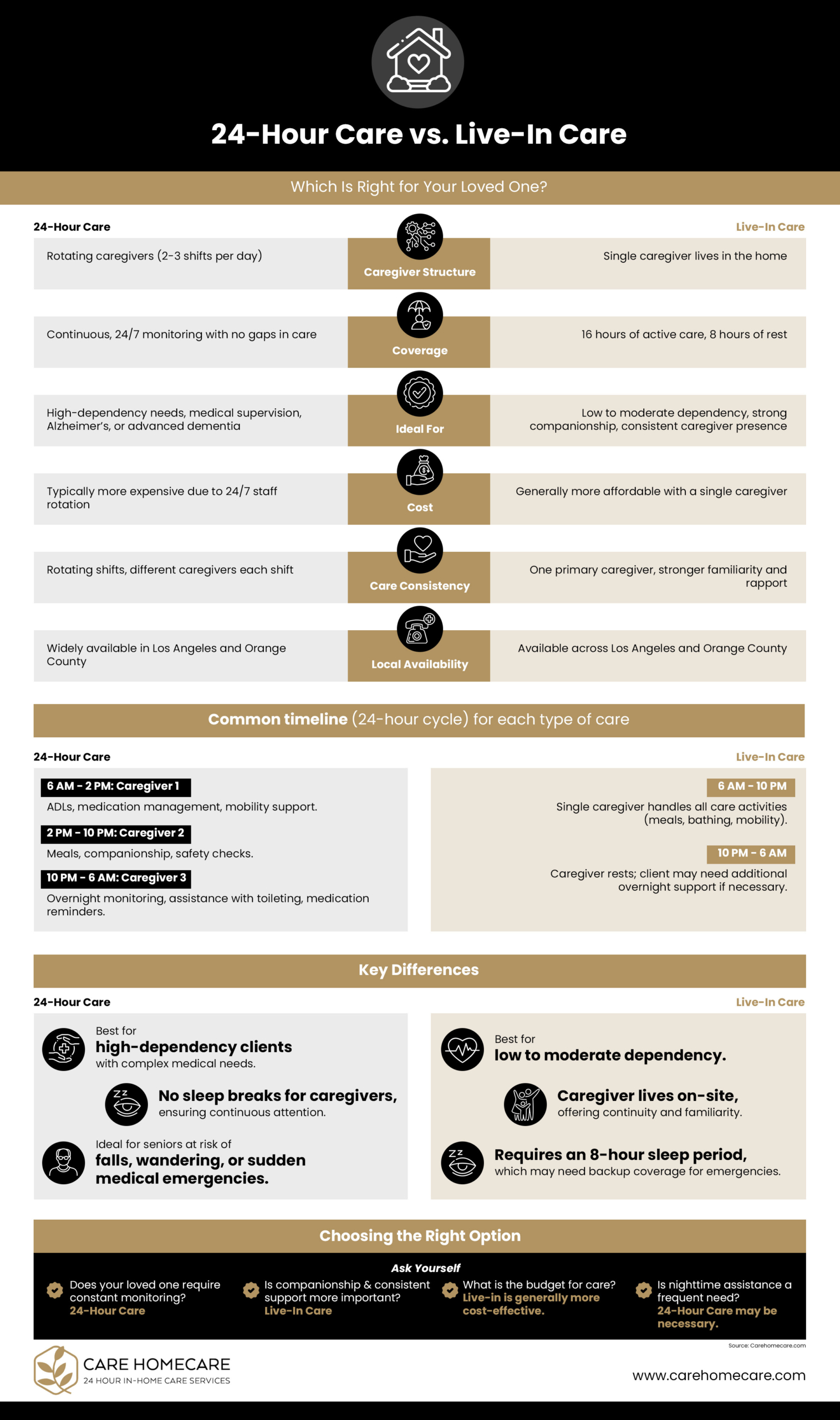
24-hour care is designed for seniors who require continuous monitoring and assistance throughout the day and night. This model involves two or three rotating caregivers who provide non-stop attention, ensuring that someone is always available to assist with Activities of Daily Living (ADLs), medication reminders, mobility support, and safety supervision. To keep multiple caregivers aligned, families often use structured 24/7 home care documentation logs and checklists to record daily activities, vitals, and shift notes.
This is ideal for:
– Seniors with advanced Alzheimer’s or dementia
– Individuals recovering from surgery
– Those with mobility challenges or risk of falls
With 24-hour care, families can have peace of mind knowing that their loved one is always attended to, even during overnight hours.

What Is Live-In Care?
Live-in care differs from 24-hour care in its structure. A single caregiver lives in the home with the senior, providing assistance for the majority of the day. The caregiver typically requires a designated 8-hour sleep period and break times throughout the day. While this model is less intensive than 24-hour care, it allows for more personalized and consistent support from the same caregiver.
Live-in care is suitable for:
– Seniors who are mostly independent but need occasional assistance
– Individuals who benefit from consistent, familiar companionship
– Those with minimal overnight care needs
Key Differences Between 24-Hour Care and Live-In Care
- Aspect
- Caregiver Structure
- Coverage
- Ideal For
- Cost
- Care Consistency
- 24-Hour Care
- Rotating caregivers (2-3 per day)
- Continuous, 24/7 monitoring
- High-dependency needs, medical care
- Typically more expensive
- Caregivers rotate shifts
- Live-In Care
- Single caregiver with designated sleep time
- 16 hours of active care, 8 hours of rest
- Low to moderate dependency, companionship
- Generally more affordable
- One primary caregiver builds rapport

Local Care Options in Los Angeles and Orange County
Both 24-hour in-home care and live-in care services are widely available throughout Los Angeles and Orange County. Local agencies are equipped to provide flexible, community-focused support tailored to individual needs.
Learn more about 24-hour home care services in Los Angeles provided by CARE Homecare.
Intensive In-Home Support Services
If you’re considering 24-hour or live-in care for your loved one in Los Angeles or Orange County, contact CARE Homecare today at (323) 851-1422 to schedule a free consultation. Let us help you make the best choice for their comfort and well-being.
 https://carehomecare.com/wp-content/uploads/2026/05/Post-Surgery-Home-Care-Checklist-Non-Medical-Support-for-Recovery-at-Home-Free-PDF-and-Word-Download.jpg
839
1315
Moti Gamburd
https://a81019caredemo.wpengine.com/wp-content/uploads/2019/08/CARE-Homecare-Logo-wht.png
Moti Gamburd2026-05-14 20:03:392026-05-14 20:03:39Free Post-Surgery Home Care Checklist | Non-Medical Support for Recovery at Home | PDF or Word Print or Download
https://carehomecare.com/wp-content/uploads/2026/05/Post-Surgery-Home-Care-Checklist-Non-Medical-Support-for-Recovery-at-Home-Free-PDF-and-Word-Download.jpg
839
1315
Moti Gamburd
https://a81019caredemo.wpengine.com/wp-content/uploads/2019/08/CARE-Homecare-Logo-wht.png
Moti Gamburd2026-05-14 20:03:392026-05-14 20:03:39Free Post-Surgery Home Care Checklist | Non-Medical Support for Recovery at Home | PDF or Word Print or Download https://carehomecare.com/wp-content/uploads/2026/05/Home-Care-Supplies-Preparation-Checklist.jpg
842
1316
Moti Gamburd
https://a81019caredemo.wpengine.com/wp-content/uploads/2019/08/CARE-Homecare-Logo-wht.png
Moti Gamburd2026-05-14 18:49:452026-05-14 18:49:45Home Care Supplies Checklist | What to Have Ready Before Care Starts | Free Printable PDF
https://carehomecare.com/wp-content/uploads/2026/05/Home-Care-Supplies-Preparation-Checklist.jpg
842
1316
Moti Gamburd
https://a81019caredemo.wpengine.com/wp-content/uploads/2019/08/CARE-Homecare-Logo-wht.png
Moti Gamburd2026-05-14 18:49:452026-05-14 18:49:45Home Care Supplies Checklist | What to Have Ready Before Care Starts | Free Printable PDF https://carehomecare.com/wp-content/uploads/2026/05/Light-Housekeeping-Checklist-for-Home-Caregivers-1.jpg
832
1080
Moti Gamburd
https://a81019caredemo.wpengine.com/wp-content/uploads/2019/08/CARE-Homecare-Logo-wht.png
Moti Gamburd2026-05-13 11:11:172026-05-14 02:13:21Light Housekeeping Checklist for Home Caregivers | Free Printable PDF
https://carehomecare.com/wp-content/uploads/2026/05/Light-Housekeeping-Checklist-for-Home-Caregivers-1.jpg
832
1080
Moti Gamburd
https://a81019caredemo.wpengine.com/wp-content/uploads/2019/08/CARE-Homecare-Logo-wht.png
Moti Gamburd2026-05-13 11:11:172026-05-14 02:13:21Light Housekeeping Checklist for Home Caregivers | Free Printable PDF https://carehomecare.com/wp-content/uploads/2026/05/Home-Safety-Checklist-for-Seniors-Free-Printable-Room-by-Room-Guide-PDF-Download.jpg
804
1042
Moti Gamburd
https://a81019caredemo.wpengine.com/wp-content/uploads/2019/08/CARE-Homecare-Logo-wht.png
Moti Gamburd2026-05-12 01:27:302026-05-13 02:09:16Home Safety Checklist for Seniors | Room by Room (Free Printable PDF)
https://carehomecare.com/wp-content/uploads/2026/05/Home-Safety-Checklist-for-Seniors-Free-Printable-Room-by-Room-Guide-PDF-Download.jpg
804
1042
Moti Gamburd
https://a81019caredemo.wpengine.com/wp-content/uploads/2019/08/CARE-Homecare-Logo-wht.png
Moti Gamburd2026-05-12 01:27:302026-05-13 02:09:16Home Safety Checklist for Seniors | Room by Room (Free Printable PDF) https://carehomecare.com/wp-content/uploads/2026/05/In-Home-Care-Agency-Checklist-Questions-to-Ask-Before-You-Hire.jpg
831
1078
Moti Gamburd
https://a81019caredemo.wpengine.com/wp-content/uploads/2019/08/CARE-Homecare-Logo-wht.png
Moti Gamburd2026-05-04 01:29:142026-05-13 02:07:13In-Home Care Agency Checklist | Questions to Ask Before You Hire
https://carehomecare.com/wp-content/uploads/2026/05/In-Home-Care-Agency-Checklist-Questions-to-Ask-Before-You-Hire.jpg
831
1078
Moti Gamburd
https://a81019caredemo.wpengine.com/wp-content/uploads/2019/08/CARE-Homecare-Logo-wht.png
Moti Gamburd2026-05-04 01:29:142026-05-13 02:07:13In-Home Care Agency Checklist | Questions to Ask Before You Hire https://carehomecare.com/wp-content/uploads/2026/05/Dementia-Daily-Caregiver-Checklist-Free-Printable-PDF-for-Home-Care.jpg
831
1078
Moti Gamburd
https://a81019caredemo.wpengine.com/wp-content/uploads/2019/08/CARE-Homecare-Logo-wht.png
Moti Gamburd2026-05-03 00:17:592026-05-13 02:09:49Dementia Daily Caregiver Checklist | Free Printable PDF for Home Care
https://carehomecare.com/wp-content/uploads/2026/05/Dementia-Daily-Caregiver-Checklist-Free-Printable-PDF-for-Home-Care.jpg
831
1078
Moti Gamburd
https://a81019caredemo.wpengine.com/wp-content/uploads/2019/08/CARE-Homecare-Logo-wht.png
Moti Gamburd2026-05-03 00:17:592026-05-13 02:09:49Dementia Daily Caregiver Checklist | Free Printable PDF for Home Care https://carehomecare.com/wp-content/uploads/2026/05/ADL-IADL-Checklist-for-Seniors-Free-Printable-Assessment-PDF-Download.jpg
795
1041
Moti Gamburd
https://a81019caredemo.wpengine.com/wp-content/uploads/2019/08/CARE-Homecare-Logo-wht.png
Moti Gamburd2026-05-01 17:41:202026-05-13 02:10:25ADL / IADL Checklist for Seniors - Free Printable Assessment (PDF Download)
https://carehomecare.com/wp-content/uploads/2026/05/ADL-IADL-Checklist-for-Seniors-Free-Printable-Assessment-PDF-Download.jpg
795
1041
Moti Gamburd
https://a81019caredemo.wpengine.com/wp-content/uploads/2019/08/CARE-Homecare-Logo-wht.png
Moti Gamburd2026-05-01 17:41:202026-05-13 02:10:25ADL / IADL Checklist for Seniors - Free Printable Assessment (PDF Download) https://carehomecare.com/wp-content/uploads/2026/05/Free-Printable-Caregiver-Daily-Checklist-for-Elderly-PDF-Download.jpg
877
1352
Moti Gamburd
https://a81019caredemo.wpengine.com/wp-content/uploads/2019/08/CARE-Homecare-Logo-wht.png
Moti Gamburd2026-04-21 16:12:122026-05-14 02:01:30Free Printable Caregiver Daily Checklist for Elderly (PDF Download)
https://carehomecare.com/wp-content/uploads/2026/05/Free-Printable-Caregiver-Daily-Checklist-for-Elderly-PDF-Download.jpg
877
1352
Moti Gamburd
https://a81019caredemo.wpengine.com/wp-content/uploads/2019/08/CARE-Homecare-Logo-wht.png
Moti Gamburd2026-04-21 16:12:122026-05-14 02:01:30Free Printable Caregiver Daily Checklist for Elderly (PDF Download) https://carehomecare.com/wp-content/uploads/2026/03/24-7-vs-12-Hour-Shifts-for-Home-Care.jpg
1706
2553
Mendy Perlman
https://a81019caredemo.wpengine.com/wp-content/uploads/2019/08/CARE-Homecare-Logo-wht.png
Mendy Perlman2026-03-14 03:46:542026-03-15 03:52:2924/7 vs 12-Hour Shifts for Home Care - Coverage Models to Compare
https://carehomecare.com/wp-content/uploads/2026/03/24-7-vs-12-Hour-Shifts-for-Home-Care.jpg
1706
2553
Mendy Perlman
https://a81019caredemo.wpengine.com/wp-content/uploads/2019/08/CARE-Homecare-Logo-wht.png
Mendy Perlman2026-03-14 03:46:542026-03-15 03:52:2924/7 vs 12-Hour Shifts for Home Care - Coverage Models to Compare
